

Using AI in Your Firm’s Rebrand


Any investment firm staying afloat in 2026 is leveraging AI in its day-to-day. A corporate rebrand may seem a tempting place to deploy AI and its efficiencies: it’s fast, and it can pressure-test an idea from angles a small team (or a busy team) won't think to try.
It's also intimidatingly good at producing something that looks finished before any thinking is done. A brand (in both its visuals and its narrative) is nothing more than the product of a set of decisions: what the firm stands for, who it's talking to, and what it's willing to give up to say that clearly.
AI can inform every one of those decisions. It shouldn't make any of them.
We see three places where AI belongs in a rebrand, each with a line worth drawing.
1. Use AI to Find the Holes in Bold Messaging
Messaging bold enough to signal a shift will leave gaps. Repositioning after a weaker fund’s performance, addressing a leadership departure, announcing a shift in investment focus: every new statement worth making will claim some ground and give up other ground.
Say your firm moves its messaging to be more founder-focused — that transition will, in any scenario (and to whatever degree), be made at the expense of LP-focused messaging. That may be the right trade, but you should feel informed before taking that leap.
Ask AI to map your options for you:
- Which audiences each message serves. An LP, a founder, and an intermediary will read the same sentence differently.
- Where each creative direction is aimed, and what it leaves out.
- The questions a skeptical reader will ask that the new messaging no longer answers.
Then have it weigh the pros and cons of each. Any brand bold enough to make a new statement will inherently sacrifice (or, at minimum, deprioritize) something else. Better to see those sacrifices before you commit to them.
Darien Group’s Tool of Choice: Claude and ChatGPT both handle this well.
Don't Let AI Make Any Decision
AI is a great researcher and a generationally abysmal decision maker. Take what it finds into a conversation amongst stakeholders, but let hearts, guts, and brains make the call.
AI also cannot be held accountable. If it talks you into a position you walk back a year later, the explanation that "Claude told me to do it" is thin, indefensible, and embarrassing. Let Claude diligence your inputs. You decide whether to pull the trigger.
Don't Let AI Talk You Out of Being Bold
AI is good at spotting vulnerabilities, and every bold claim has some. Listen to it, but don't let it move your gut instinct more than ten degrees. A firm that kowtows to every flagged risk ends up sounding like the competitors it has spent time and resources to differentiate from.
Let AI do your research. Remember to then make bold, inspired decisions.
2. Use AI to Widen Your Creative Research
Few people can describe a visual direction before they've seen it. Let’s face it: if you could, you might have ended up a creative director. Most people are much better at reacting to creative than generating. AI is a fast way to gather things to react to: references, examples, and approaches outside your usual frame, so you can work out what you like, what you don't, and why.
Darien Group’s proprietary rangefinding process already does this. But a firm that arrives having narrowed its likes and dislikes (with some sense of where it wants to go) allows us to make that rangefinding exercise that much tighter and more specific. This raises the odds that we collectively land on the right creative concept sooner and more efficiently.
A prompt like this is a good place to start:
- Show me the look and feel of 10 firms doing deals like we are and raising capital from similar sources. Break down the components of their look and feel, and what each component and the overall vibe communicate. Here are five competitors I know of [insert list]. You pull the other five.
Darien Group’s Tool of Choice: ChatGPT is usually the better tool for research of this nature.
Don't Let AI Design Your Brand
Your logo, guidelines, typefaces, colors, and textures should come from people — not SaaS.
The inputs you share with generative AI tools have a limited influence on its output, so any AI’s creative work reflexively snaps to the most sanitized version of any idea. It’s worth noting that AI design tools are also built mostly for app UI, like eCommerce sites and analytics dashboards. AI platforms don't understand brand as a way to tell a story, and they do not understand the gravity of its role in raising capital.
Put a creative brief into AI and you won't get an expert brand back. Building a visual brand on top of a strategy is an art form, and it is only successful when measured by the metrics of how that brand makes people feel. Human instinct will invariably beat AI output in this category one thousand times out of one thousand, because AI can never know how a brand makes people feel. It can only know what a brand endeavors to make people feel, but not how those people process what they receive. Human people are the only testing ground for that.
3. Use AI to Extend a Finished Brand
Once your new brand is finalized and live across its core touchpoints (presentations, collateral, LinkedIn, the website), AI becomes useful again — this time for keeping everything consistent.
Feed your formalized brand guidelines and the finished collateral from your rebrand into Claude, and build a skill trained on them: a saved set of instructions and examples Claude draws on whenever it works on your materials. Associates and deal teams can then produce satellite collateral, like diligence decks and conference invites, that stays on brand without a designer touching every page.
By this point, the creative decisions have been made. AI's job is to repeat them accurately (dozens of times a year) with less impact on your firm’s marketing spend and bandwidth.
Darien Group’s Tool of Choice: Claude is a better design execution tool.
Don't Let AI Invent New Mediums
A skill trained on your brand should reproduce what already exists. It shouldn't introduce net-new kinds of collateral. Don't, for example, ask it for a first pass at an investor deck based on your website.
A website and an investor deck have different audiences and, therefore, do different jobs — we often push for different micro-expressions of the brand in each medium. Working out that translation is brand work. It demands a person because each expression lives and dies by its audience.
And Don't Let AI Build Your Website
AI writes websites in straight HTML by default, with little regard for the modular CMS structure that keeps a site sustainable, future-proofed, and manageable for whoever maintains it.
Ask AI for a website and you'll get one built around whatever you asked for that week. It may look fine at launch. A year later, when you need to add a page for a new strategy or rework the team page, it will drive you mad. AI can't anticipate your future needs the way an agency that has spent more than ten years building investment firm websites can — no matter how you prompt it.
In short: Let AI open up your research. Never let it make your decisions.
Until your investors are running your materials through AI and deploying capital only on its directive (a day we hope and are certain will never come), investment decisions ultimately get made based on human choice. Sure, AI provides labor; but people back the decisions. And if AI isn't the one deciding whether to allocate capital to your firm, walking into any meeting with AI-generated brand, content, and copy is an unrecoverable handicap. Overreliance on AI during your premium rebrand is a similarly ill-fated mistake.
Darien Group runs rebrands for investment managers, from positioning through the website. Learn more about our messaging and positioning, visual brand development, and private equity website work.
Read More

For about four years in the 2000s, I ran Platinum Equity's deal announcement program. Back then, an announcement was a printed mailer that landed on desks, often with an email version sent alongside it. They took real production: multi-panel folds, original photography, and a full account of the deal. I still have proofs of a few, including the 2010 Broadleaf piece shown near the end of this post. Full disclosure: I worked at Platinum for eight and a half years, and Platinum has never been a Darien Group client. I'm writing about them because I admire what they're doing.
Twenty years later, the medium is email and the program is run by a different team, but the instinct is the same. I've kept every Platinum deal email that has landed in my inbox since early 2025, about two dozen in all. Read together, they show something unusual in private equity marketing: a firm that treats each transaction as a chance to prove what it is good at, and is willing to put the evidence in writing.
Who is a private equity deal announcement email for?
Platinum's emails are written for the people who bring it deals: investment bankers, intermediaries, corporate development teams, and business owners thinking about a sale. The tell is in the details. The emails come from a business development address, and every one ends with a "Partner with us" block naming Johnny Lopez, Partner, Global Business Development. When the topic is private credit, the contact switches to Michael Fabiano, Global Head of Credit. The person you're invited to call matches the strategy you just read about.
The clearest example is an email from May 2026 titled "Actively seeking add-ons for Infratech, a Platinum portfolio company." It describes the business, quotes the deal team on the kinds of tuck-in and transformational acquisitions they want, and asks the reader to get in touch. It is a sourcing request, written as news.
That focus matters, because most firms write deal announcements for no one in particular. An email that knows its reader can be specific about what it wants that reader to do next.
What does a bad deal sourcing email look like?
Compare Infratech with the sourcing emails most of us actually get. Here is a typical one, from a lower-middle-market firm I won't name. The subject line is "[Firm name] – Quick Check-In." The sender is reaching out "once more to stay connected." The firm is "actively seeking" majority investments in founder-owned businesses. Then come five bulleted sectors, an EBITDA range, a line about moving "quickly and thoughtfully," and an invitation to get in touch if anything comes to mind.
If you work anywhere near the deal business, you've received dozens of these. Nothing in it tells a banker why this firm is a better home for a founder's company than the fifty others sending the same email. There's no deal, no portfolio company, no person other than the sender, and no evidence. The sector list could belong to hundreds of firms, and every firm says it moves quickly.
The one distinctive element is a 4% referral fee at closing. That's concrete and unusual, and it's buried in the last sentence of the email.
The Infratech email has the same goal: find deals. But it names the platform, explains what makes it attractive, says what kinds of add-ons the team wants, and quotes the two people who will do the deal. One gives the reader a reason to remember the firm. The other gets archived.
Should private equity firms publish portfolio company performance?
They should publish more than they do, and Platinum shows what that looks like. When it sold Urbaser, the Madrid-based waste and environmental services company, to Blackstone and EQT for $6.6 billion, the email set the exit price next to the roughly $4.2 billion Platinum paid in 2021. Then it put the results in large type:
- €1.6B in combined capex and M&A investment over five years
- 60%+ revenue growth since 2020
- 70%+ EBITDA growth since 2020
The De Wave exit email did the same for an Italian marine interiors business. It said Platinum more than doubled revenue and EBITDA from acquisition levels and grew the backlog from about €500 million to more than €1 billion.
I rarely see numbers like these from a private equity firm in anything public. The usual reason is not the deal team. It's the general counsel, who reads every draft and says no to the growth figure, the margin and the backlog until what's left is "a leading provider of" and a quote about partnership. Each of those calls makes sense on its own. Added together, they produce announcements that sound the same at every firm.
Platinum's numbers aren't hidden. The same figures appear in its press releases on its own website, and anyone can sign up for the emails. The email simply takes numbers someone has already approved and puts them where the reader will see them first.
That's the lesson for other firms. A growth figure that has already been cleared is worth more in large type in the first screen of an email than in the sixth paragraph of a press release. And if you can't clear any numbers, ask what you can clear. A bit more transparency with the people who send you deals is one of the few real differentiators left in a market where every firm claims operational value creation.
What should a private equity deal announcement email include?
Platinum uses the same structure nearly every time, and the consistency is a big part of why it works. Readers learn where to look. The order:
- A subject line with the news in it. "Platinum Equity to sell Heat Controller to Lennox (NYSE: LII)." Names, tickers, dollar figures. Once, for the Husky-CompoSecure reverse merger, the subject line was a quote: "It's like getting to the mature stage after an IPO without the teenage years."
- Preview text that adds the thesis. The Urbaser email's preview line read "Transformation included strategic M&A, active portfolio management, operational improvement, and disciplined capital allocation." The story starts before the email is opened.
- The deal in one or two sentences, with a link to the full press release.
- A short description of the company, written in plain language.
- Stat tiles where the numbers can be shared: customers, employees, enterprise value, growth.
- Two quotes: one from a Co-President and one from the managing director who led the deal. Each one does its own job. In the Urbaser email, Louis Samson's quote is about structuring the deal for the buyer, a message aimed at bankers. Igor Chacartegui's is about Platinum's local team in Spain and Europe.
- A module connecting the deal to a strategy (more on this below).
- A named person to contact.
The emails are also built well. The headlines, numbers and quotes are live text, not pictures of text, so they still read in an Outlook inbox with images turned off, which describes a lot of inboxes in finance.
Every deal is evidence for the strategy
The most important thing these emails do is use each transaction to prove something about the firm. Platinum describes its approach with a registered service mark, M&A&O® (mergers, acquisitions, operations). On exits, the emails include a module called "M&A&O® at Work" that lists what was done during ownership. For Unical Aviation it was a checklist: a new leadership team, modernized technology, an optimized footprint, a diversified inventory, a dedicated asset management team and add-on acquisitions. For Heat Controller it included the acquisition of Global, the Source and the sale of the parts division to CSW Industrials.
The module took time to settle. In May 2025 it appeared as "Platinum M&A at Work," and in December 2025 as "Platinum's Operational Transformation Highlights." By 2026 it was "M&A&O® at Work" on every exit. That's a team refining a format on purpose, not a template filled in once and forgotten.
Acquisition emails do the same job with a second module tied to the relevant part of the firm:
- Solo Group (European B2B products): Platinum's European team and its 20-plus years on the continent
- Anuvu and LMPG: the Small Cap strategy, presented as core to the firm since its founding (Infratech's add-on email names the $2.28 billion second fund)
- Kodak Alaris: Platinum Credit, with its EBITDA range and the types of financing it provides
- Owens & Minor P&HS: the firm's healthcare portfolio
- PERANEL, the joint venture with Nestlé: a history of corporate partnerships, including Rehlko (formerly Kohler Energy), Horizon Organic and Ball Metalpack, with retained equity pitched as "a second bite at the apple" for corporate sellers
A reader who sees one of these emails learns about a deal. A reader who sees a year of them learns what Platinum does, for whom, and how to bring it a deal. Most firms have a positioning statement on their website. Platinum backs its own up with a new example every few weeks.
Telling the whole story
Two emails for a big exit. Urbaser got one email at signing in March 2026 and another at closing in October. Unical got one at signing in December 2025 and one at closing in May 2026. The second email isn't a repeat. It adds what has been learned in the meantime, so the story gets richer instead of being told once and dropped.
Honesty about what went wrong. The De Wave email says Platinum bought the business in 2019, and that within months it was "operating near the epicenter of Europe's initial COVID-19 outbreak while serving an industry brought to a near standstill." Louis Samson's quote calls the rebuild "a remarkable story of achievement, perseverance and teamwork." The Sunrise Medical email describes a turbulent deal process with shifting interest rates and uncertain financing. Most firms would leave all of that out. Including it is what makes the result believable, and it's a big part of the real excitement these emails carry.
Original photography and video. The pictures are commissioned for the deal: Urbaser crews at work on the Barcelona waterfront, Platinum partners photographed together, not stock images of handshakes. Several emails link to videos in which Platinum and portfolio company executives discuss the deal (Héroux-Devtek, Sunrise Medical, Urbaser). The quote blocks belong to Platinum's own people; the videos are where management teams speak.
The year in review. In February 2026, Platinum sent a 2025 recap: 73 deals, made up of 11 new platforms, 48 add-ons, 11 divestitures and 3 credit deals. Each email on its own is a deal announcement. Over a year, together, they make the case for the firm.
A checklist for your next deal announcement email
- Know your reader. Decide whether you're writing for deal sources, LPs, portfolio company talent or the press, and name a person they can contact.
- Put the news in the subject line. Use names, numbers and tickers; save the cleverness for later.
- Use the preview text. Give the thesis a second line before the email is opened.
- Publish at least one real number. Revenue growth, EBITDA growth, backlog, add-ons completed, entry and exit value. If the press release already has it, move it to the top of the email.
- Make each quote do its own job. One on the strategy, one on the company. Skip the generic "we're excited to partner" line.
- Tie the deal to a strategy. Add a module showing what this deal proves about your firm.
- Use original photography. Real people and real operations, not stock imagery.
- Tell the hard parts. A setback you got through is more convincing than a smooth story.
- Follow the deal through. Send at signing and at closing, then sum up the year.
- Build it in live text. Make sure it reads on a phone and in Outlook with images off.
- Be consistent. Use the same structure every time, so readers learn where to look.
Same instinct, twenty years apart
When I pulled up proofs of our 2009 and 2010 mailers to write this, the resemblance was hard to miss. The Pomeroy piece listed the same bdcontact@platinumequity.com address the emails come from today. It already relied on the M&A&O® mark, and it closed with "If a transaction is in your future, please give us a call," naming a business development contact in each office. The Broadleaf piece opened on a photograph of a worker strapping down a load of building materials under the headline "Our latest deal." Inside, it told the story of a Weyerhaeuser carve-out that became a standalone company and then merged into a public one, with Platinum keeping a stake. Swap the printer for an email platform and you have the Urbaser and PERANEL emails.
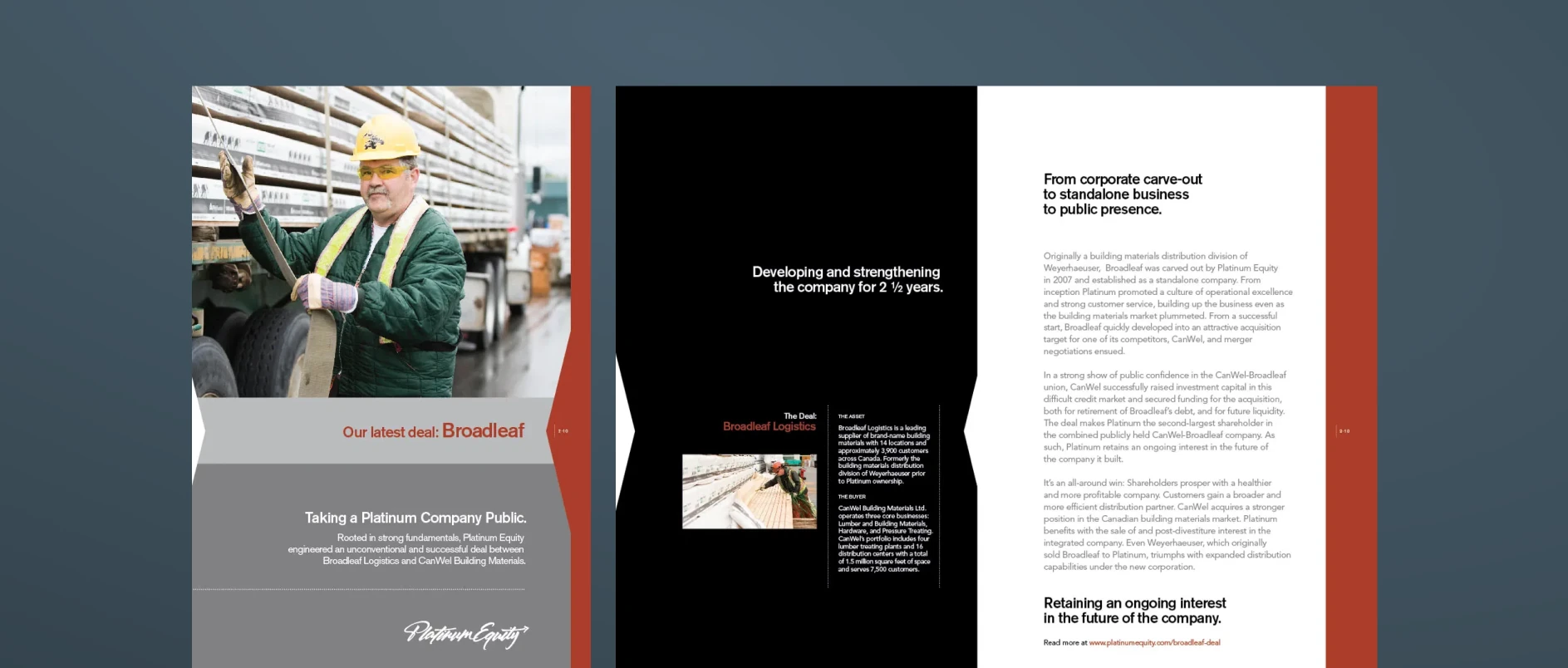
Platinum's 2010 Broadleaf announcement, cover and inside (agency proof).
You don't need Platinum's deal volume to do the same. You need a structure you use every time, one number your counsel will let you publish, and a clear idea of who's reading.
Sources
- Platinum Equity press release: sale of Urbaser completed (Sept. 22, 2026)
- Platinum Equity press release: agreement to sell Urbaser (Feb. 12, 2026)
- Platinum Equity press release: agreement to sell De Wave Group (Sept. 8, 2026)
- Platinum Equity deal emails from bdcontact@platinumequity.com, February 2025 to November 2026

Most investor decks don't fail for a single reason.
Sometimes it is the design. The slides feel dated, inconsistent, or overly dense, and a cleaner visual system goes a long way.
But more often, the issue sits underneath that.
No one has made a clear decision about what the story actually is — so the deck tries to do everything at once. Strategy, track record, team, edge cases, caveats. It all gets layered in, slide by slide, until the presentation becomes harder to follow than it should be.
That's usually the moment when firms decide to “refresh the deck.”
And depending on the situation, that can mean very different things. In some cases, a design-led update is exactly what's needed. In others, the structure itself needs to be simplified, re-sequenced, and pressure-tested before design can really do its job.
The agencies below approach that spectrum from different angles. Some are pure design partners. Some operate more broadly across marketing and digital. And a smaller group works closer to the narrative itself.
If you're preparing for a fundraise or reworking core materials, understanding where your needs actually sit on that spectrum is what determines the right partner.
1. Darien Group: The Specialist Investor Presentation and Collateral Partner for All Capital Raising Firms
Darien Group is the only branding and communications firm built exclusively for investment managers. Our work centers on helping firms articulate a differentiated strategy, communicate clearly with LPs, and present a credible, cohesive identity across every touchpoint.
What makes Darien Group different:
Private-markets fluency
We work exclusively with investment managers. That specialization translates into deep understanding of fund strategy, value creation, LP expectations, GP-founder dynamics, and the nuances of middle-market fundraising.
Narrative-first strategy
Our team helps clients articulate why their strategy works - not just what they do. Positioning, messaging frameworks, and story architecture are designed specifically for LP, founder, and intermediary audiences.
Institutional investor materials
Pitchbooks, PPMs, AGM presentations, annual reports, quarterly updates, and fund overviews are built to an institutional standard, combining clarity, compliance alignment, and compelling structure.
Modular content & communication systems
We develop messaging frameworks and repeatable content structures that help investment managers communicate consistently. These systems align websites, pitch materials, and ongoing updates so a firm's story remains cohesive across every channel.
Boutique, high-touch model
Strategy, messaging, design, and execution are delivered by specialists who understand the expectations and pace of private-market teams.
Best for firms who need: a differentiated investment story, polished LP-ready materials across every touchpoint, full AGM support, and a partner with true fluency in investment management.
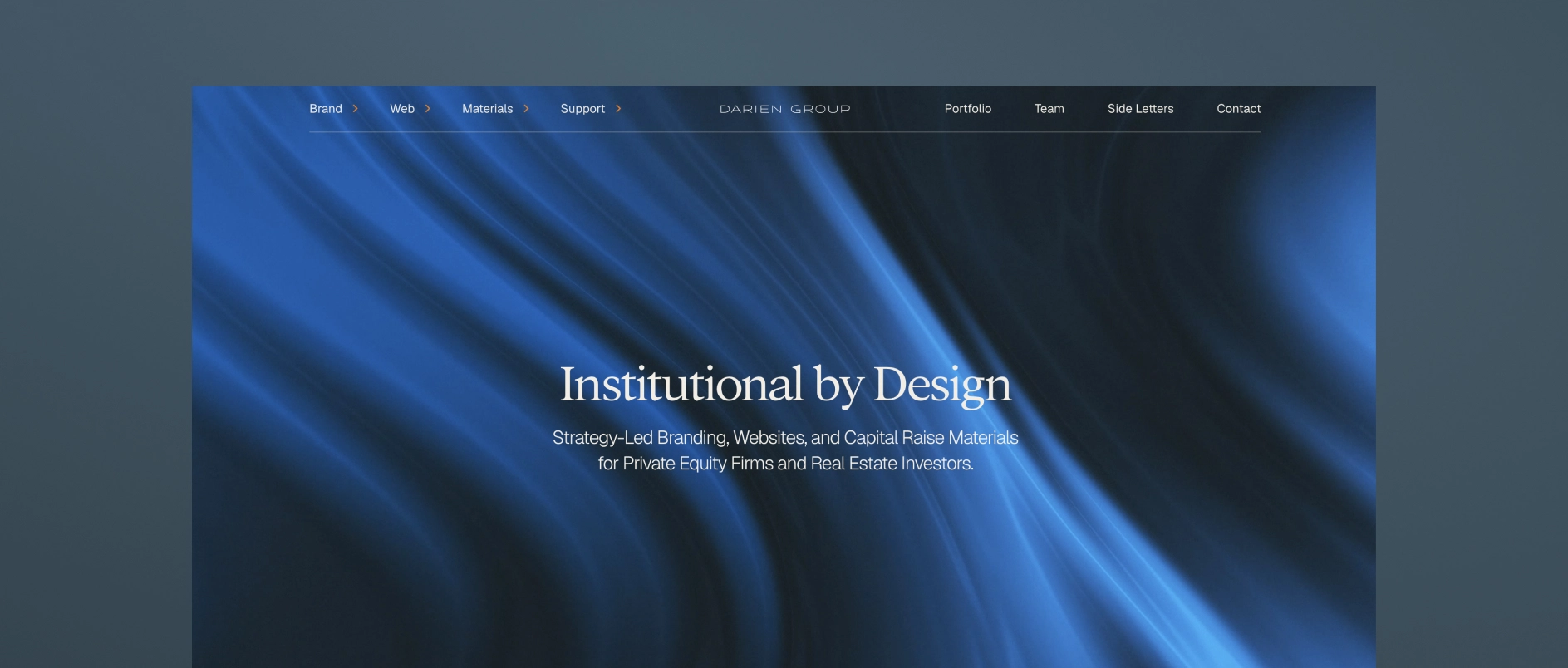
2. SlideGenius
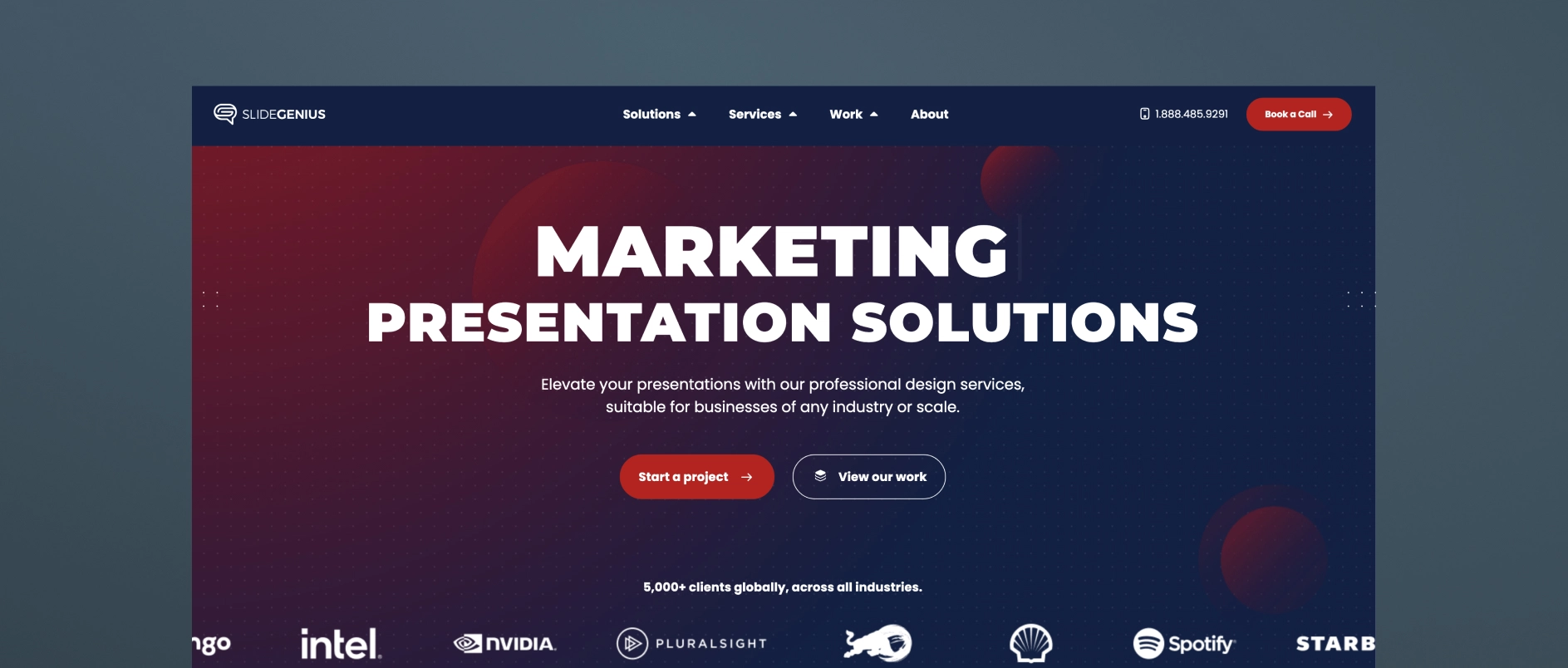
SlideGenius is a presentation design agency that produces pitch decks and sales materials across a broad range of industries. Their specialty is visual design and slide sequencing, structured around sales psychology to guide a viewer through a decision. They work with clients across sectors rather than focusing exclusively on investment managers.
Best for firms who need: a professionally designed deck produced efficiently, with a structured, repeatable process and design-forward execution.
3. Superside

Superside is a subscription-based, “always-on” design company that provides presentation design as one of many creative services — alongside branding, video, web design, illustration, and more — for scale-up and enterprise clients across industries. Their presentation work spans templates, PowerPoint and platform-specific design, pitch decks, and sales presentations, with access to motion design, illustration, and video production layered in as needed.
Best for firms who need: fast turnaround on high-volume design requests, flexible access to a broad range of creative services under one subscription, and a scalable design bench rather than a single point of strategic counsel.
4. Williams Lea
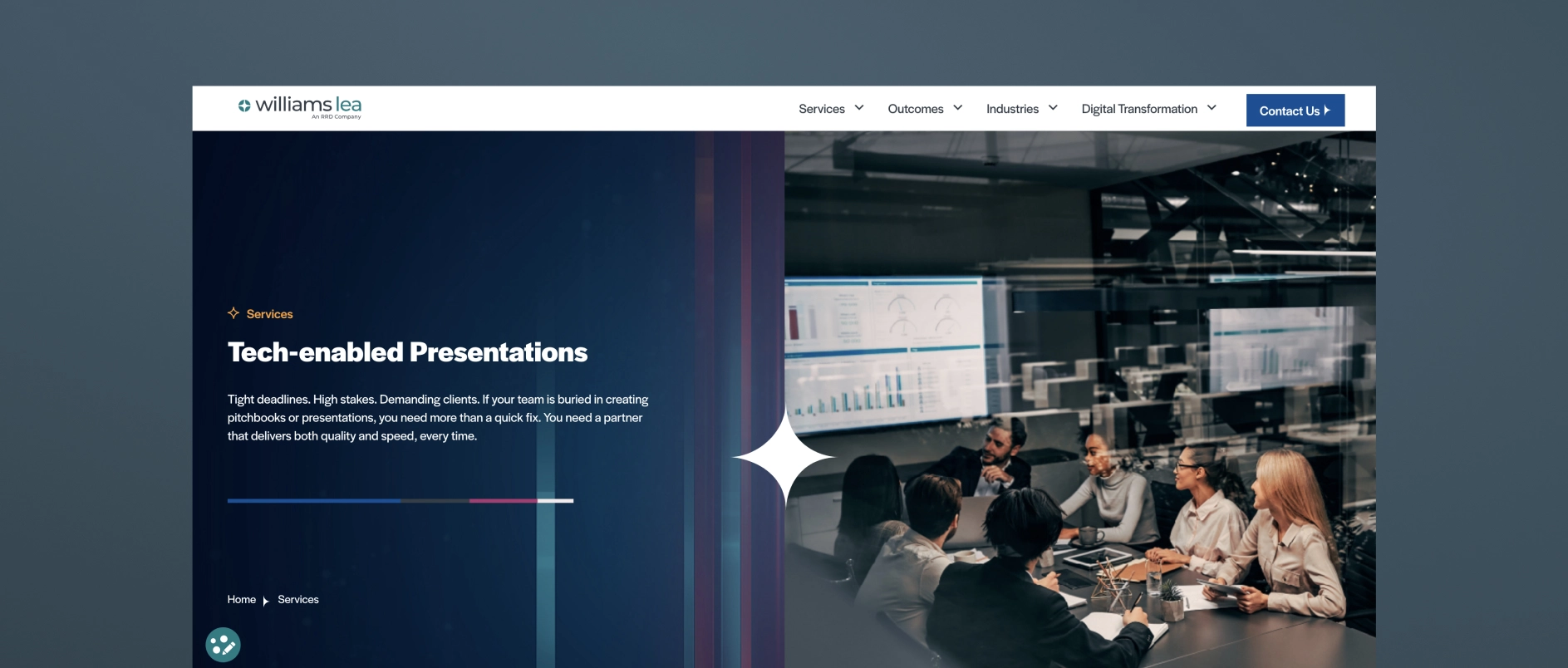
Williams Lea is a large, tech-enabled business process outsourcing (BPO) provider that offers high-volume pitchbooks and presentations as one line item alongside secretarial support, document processing, digital mail, billing support, and other back-office services. They serve financial, legal, and professional services firms specifically, and their presentation work centers on turning complex data into high-volume, tech-assisted pitchbook and PowerPoint output, often delivered under tight deadlines.
Best for firms who need: high-volume, fast-turnaround pitchbook production, execution capacity to supplement an internal team, and operational/formatting support across many other back-office functions.
5. MVP Design

MVP (MVP Marketing + Design) is a Midwest-based marketing and design firm that works specifically with private equity, M&A, and lower-middle-market firms on investor communications. Their MVP PitchMate℠ process is built around custom investor and annual meeting pitch decks, as well as CIP (confidential information presentation) work, aiming to translate complex information into clear PowerPoint visuals.
Best for firms who need: PE/M&A-specific pitch decks, LPAC and annual meeting presentations, and a firm that pairs design execution with some sector-specific investor-communications experience.
6. Investor Creative
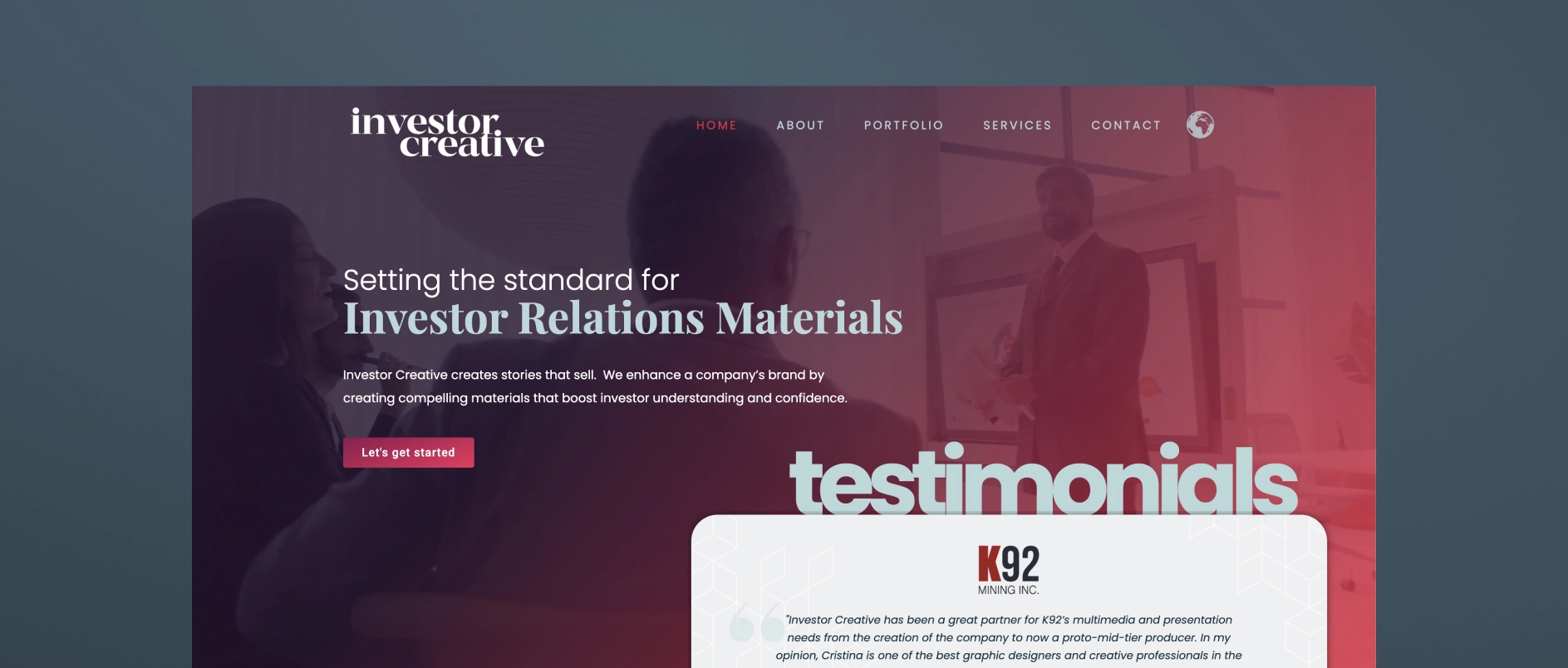
Investor Creative is a small, boutique investor relations design studio that creates presentations, websites, fact sheets, and branding materials for public and private companies. Their positioning is built around bridging the gap between a public company's limited in-house graphic capabilities and the learning curve required for a designer to understand investor appeal.
Best for firms who need: a single experienced designer who understands IR materials, presentation, and website refreshes for small-cap or junior public companies (especially resource/mining issuers), and an affordable, personal, long-term design relationship rather than a full-service agency team.
7. M'Idea Hub
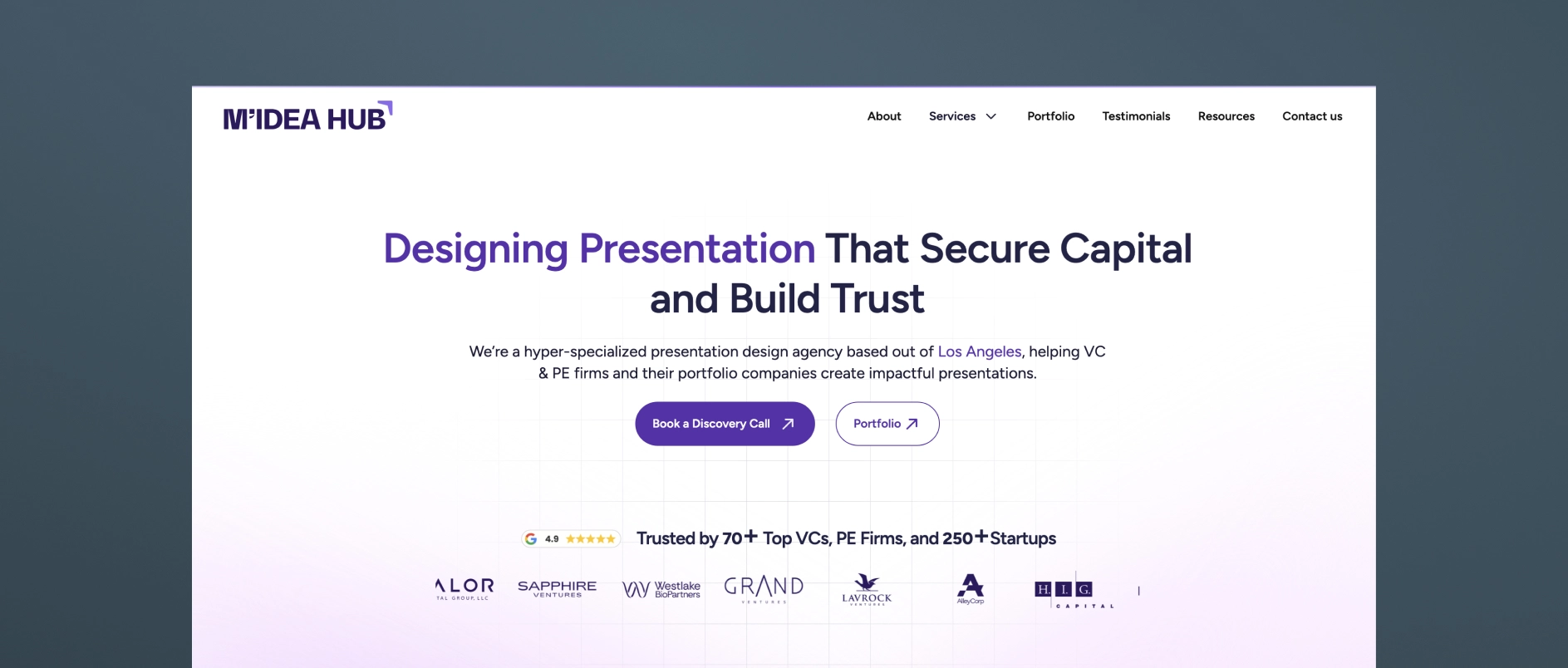
M'Idea Hub is a Los Angeles-based, boutique presentation design agency positioned specifically around VC and PE investor communications. They combine strategy, storytelling, and high-fidelity design to create fund decks, LP updates, and AGM presentations.
Best for firms who need: fund decks, LP updates, and AGM presentations for VC and PE firms that want a specialist design-and-narrative partner without a broader branding/website scope.
8. Stinson Design
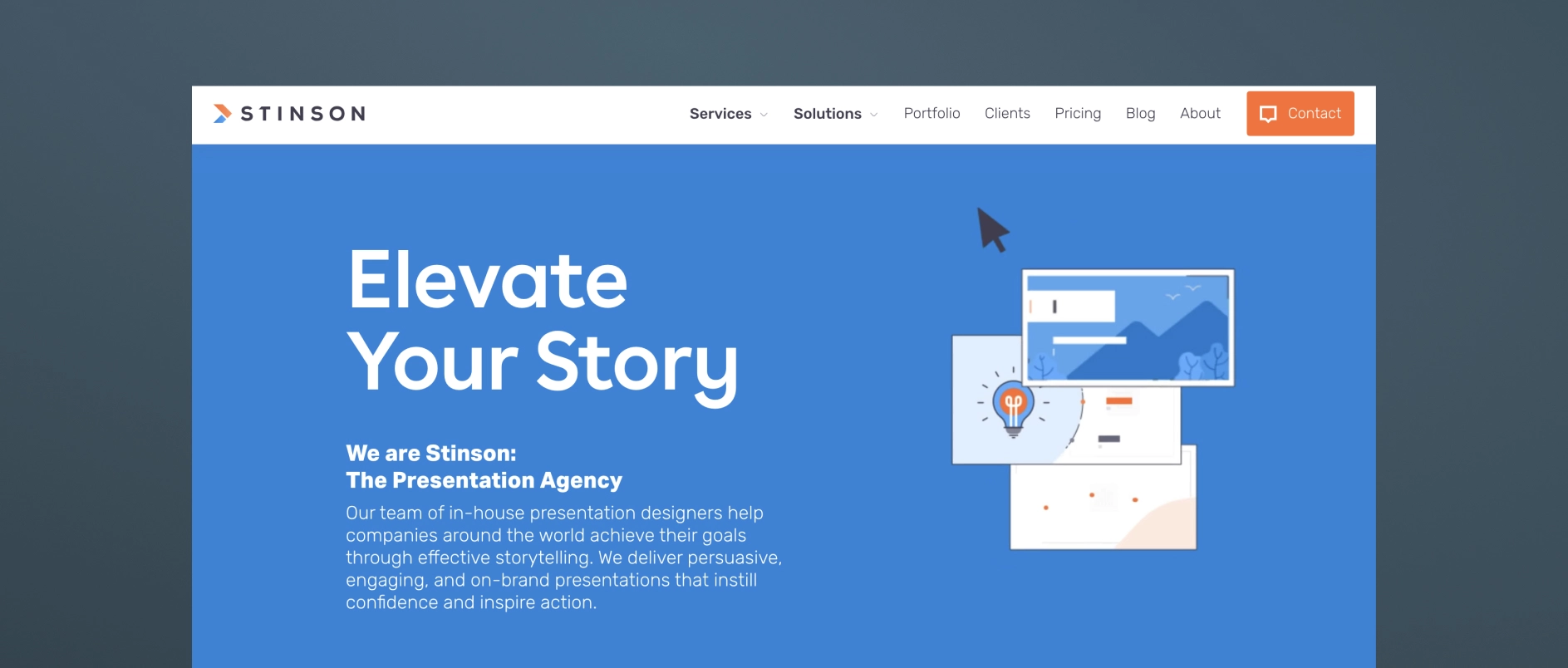
Stinson Design is a presentation design agency (Toronto-based) that has built meaningful experience in financial services and investor presentations, though it's not exclusively focused on the PE/institutional-LP niche. They've carved out a niche in investor presentations and financial storytelling, with a portfolio reflecting experience in capital markets and investment management, and clean, data-forward design suited to a financially literate, skeptical audience.
Best for firms who need: strong data-storytelling and design craft for roadshow decks, fund launch presentations, annual investor materials, or data-heavy financial analyses, from a team with real financial-sector reps but a more generalist client base overall.
9. PitchLift
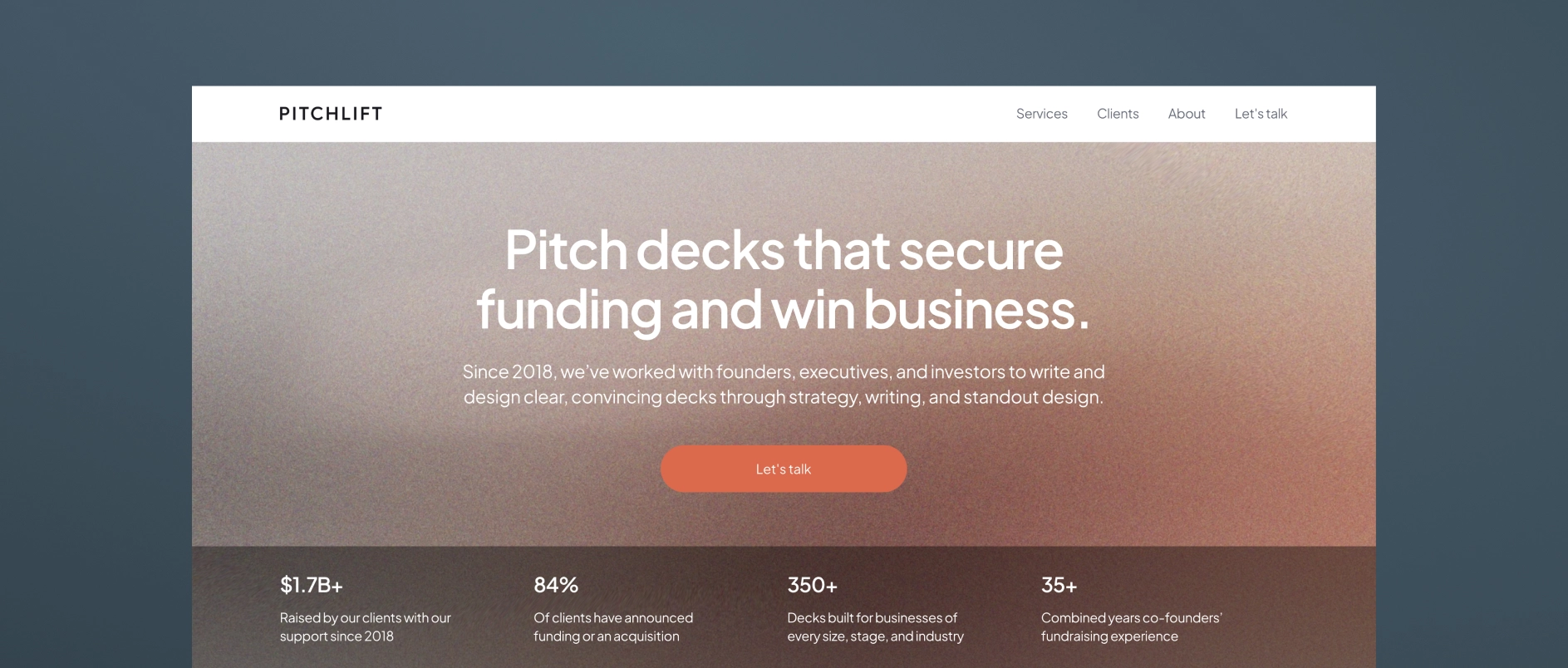
PitchLift is a small, boutique fundraising and presentation agency based in Austin and Barcelona. Their services cover graphic design, financial modeling, branding, one-pagers, and investor planning.
Best for firms who need: startups and growth-stage companies (with some enterprise/fund work) needing a lean, strategy-plus-design partner.
10. Van York Agency
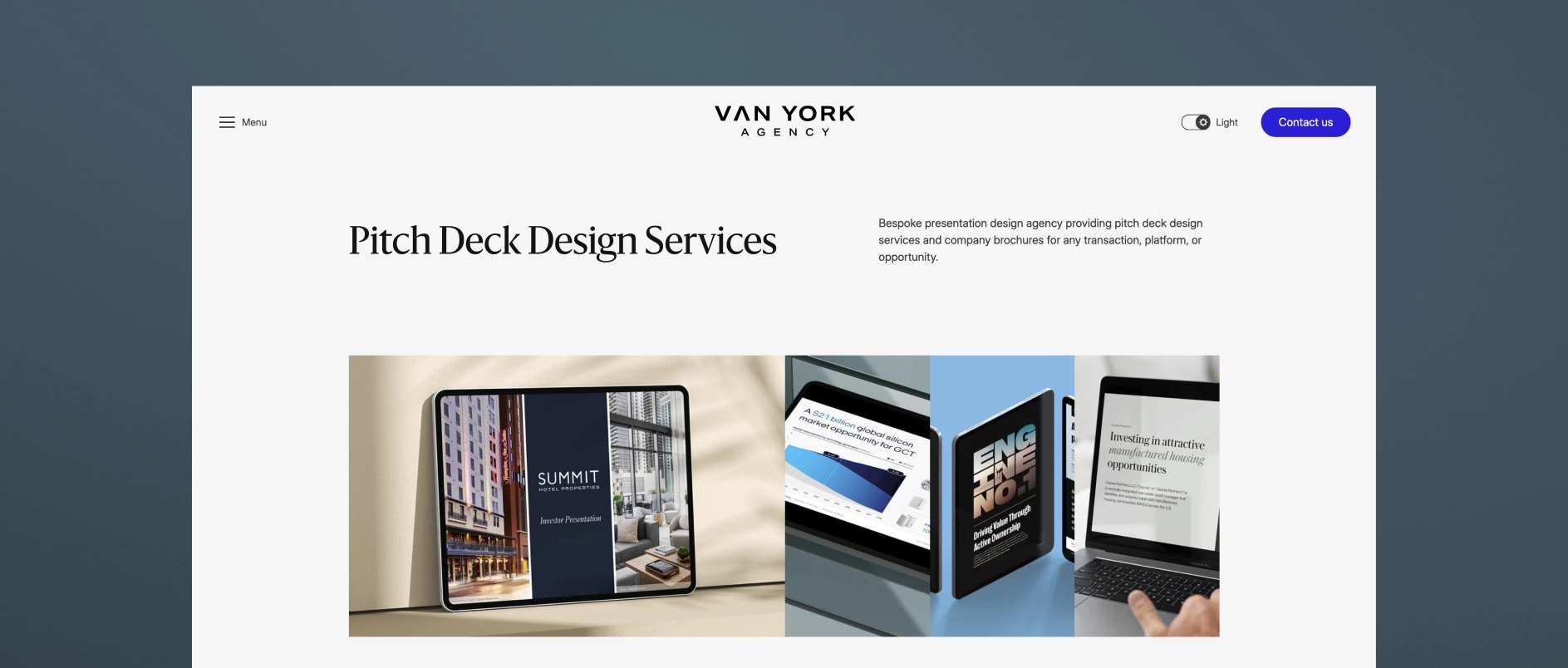
Van York is a Vancouver-based presentation and brand design agency built around end-to-end investor and B2B communications. Services span capital markets decks (IPO, SPAC, PIPE, private placement), private capital decks (seed through Series D, M&A, JV), investor relations materials (earnings, investor day, analyst day), and B2B sales/RFP decks — offering research-through-design presentation support in one shop, with fast-turnaround options.
Best for firms who need: capital markets, PE/real estate, and B2B firms needing research-through-design presentation support in one shop, with fast-turnaround options.
Darien Group works exclusively with investment management firms on brand strategy, visual identity, and digital presence. Contact us to discuss where your firm's design stands.
A rebrand at an investment firm rarely belongs to one person. Founders, managing partners, investor relations, operations, and sometimes the leaders of affiliated strategies or a board all have a stake in how the firm presents itself. That breadth of input is valuable. It is also one of the main reasons brand projects slow down.
In our experience, multi-stakeholder rebrands seldom stall because of the creative work itself. They stall when it's unclear who is providing input at each stage, who makes the final call, and what exactly is being decided. Settling those questions at the outset is often the most important step in the whole project.
Why the Process Matters as Much as the Output
Some brand deliverables are naturally harder to align on than others. Names, logos, and messaging statements are abstract and highly subjective, and each one invites a personal reaction. The more people involved, the more opportunities there are for reasonable differences of opinion to compound.
A clear process doesn't remove those differences. It gives them a place to be heard and resolved, so the project can keep moving toward one coherent brand rather than an average of many preferences.
Define Who Decides Before Anything Is Designed
The first conversation in a multi-stakeholder project is usually about structure, not creative. A few questions help bring that structure into focus:
- Who is in the day-to-day working group, and who leads it?
- Which decisions belong to senior leadership alone?
- Who holds a firm veto, and who offers advisory input?
- When should affiliated managers, committees, or board members be brought in?
- At which milestones will leadership be asked to formally approve the work before it moves forward?
It helps to make those roles visible from the start, both to the agency and to everyone inside the firm. When each stakeholder knows what they'll be asked to weigh in on, and when, feedback tends to arrive clearer and earlier. For most firms, the working group carries the bulk of the day-to-day effort, which is why how much time it requires is one of the questions investment managers ask most before a brand engagement.
Listen Broadly, Decide Narrowly
Early in a project, wide participation is an asset. Before anything is proposed, the goal is to understand how different people describe the firm, what they value, and where their views diverge. Hearing from a broad group at this stage costs little, and it often surfaces tensions that would otherwise appear much later.
As the project moves toward decisions, the circle should narrow. Input from many people informs the work; approval from a defined few moves it forward. Keeping those two roles distinct is one of the simplest ways to protect both the timeline and the clarity of the final brand.
Consolidate Feedback Before It Reaches the Work
How feedback travels can matter as much as what it says. A few practices tend to keep review rounds productive:
The internal owner doesn't need to be the most senior person at the firm. What matters most is that they have the standing to gather input from leadership and the trust to speak for the group.
Make Subjective Decisions Easier to Make
Abstract deliverables invite open-ended debate. A few principles help a group reach decisions with confidence:
- React to something concrete. Most people find it easier to respond to proposed language or a specific option than to define an answer from scratch.
- Evaluate against agreed criteria. When positioning is settled first, creative work can be judged on whether it expresses that positioning, rather than on individual preference.
- Show the work in context. A positioning statement seen on a homepage or in a deck is easier to assess than the same words on a blank page.
- Favor a clear direction over a compromise. Blending distinct options can dilute the clarity that made each one compelling.
Sequence Decisions From Strategy to Execution
Brand decisions build on one another. Positioning informs the visual identity, and the visual identity informs how the website, materials, and channels come together. Approving each layer before moving to the next keeps the group aligned and avoids revisiting foundational questions once production is underway.
If new questions surface along the way, it's usually worth pausing to resolve them. A disagreement settled at the strategy stage is far easier to address than one that emerges once a website is in development.
What an Experienced Partner Adds
An agency that has worked through many rebrands brings more than creative capability. It knows which questions about decision rights to ask early, where projects with many stakeholders tend to get stuck, and how to adjust as new information arrives. As an outside party, it can also hear competing perspectives without a stake in any one of them, and help the group find language everyone can stand behind.
The most successful projects treat that structure as part of the engagement itself, agreed with leadership at the outset rather than worked out along the way.
Alignment Is the Deliverable Behind the Deliverables
The visible outputs of a rebrand are a name, a logo, a website, and a set of materials. The less visible output is a leadership team that agrees on what the firm stands for and can describe it consistently. A thoughtful process, with clear roles, broad listening, and decisions made in sequence, is what produces that agreement. When it is in place, the creative work has a firm foundation, and the brand that emerges reflects the whole organization rather than whoever spoke last.
Darien Group runs rebrands for investment managers with many stakeholders at the table. Learn more about our messaging and positioning and visual brand development work.
Many of the conversations we have with investment firms begin with a website. The current site feels dated, the design no longer matches the firm, or a recent rebrand changed the name and logo but left everything else as it was. The request is clear: a new site.
Often, though, the firm comes to the same realization partway through the first conversation. As one head of operations put it to us recently, if the firm cannot yet articulate its value proposition, there is little reason to start on the site. The structure, the homepage, and even the visual direction all depend on an answer that hasn't been written down.
The Website Is Where Unfinished Messaging Shows
A website asks a firm to commit to specific words in a specific order. That is exactly why it exposes messaging gaps so quickly. Questions that could stay open in conversation have to be answered on the page.
None of these are design problems at their root. They are positioning questions that the website simply makes visible.
When a Rebrand Starts but Doesn't Finish
A common version of this challenge follows a rebrand that moved faster than the messaging behind it. A new name or logo may need to launch on a fixed date, tied to a transaction, a reorganization, or a new fund. The visual identity goes live, and the copy, voice, photography, and positioning are left for later.
That is a reasonable sequence, but it leaves the brand partly built. Finishing it usually means returning to the foundational layer:
- Positioning: the one idea the firm wants to be known for, stated plainly.
- Value proposition: what each audience gains from the firm, in specific terms.
- Messaging pillars: the few themes that support the positioning across every channel.
- Voice: how the firm sounds, so the website, LinkedIn, and investor materials read as one organization.
- Visual expression: photography, graphic elements, and motion that reinforce the message rather than decorate it.
Once those elements are in place, the website becomes the first full expression of the brand rather than a placeholder for it.
Why the Website Can Be the Right Vehicle for Messaging Work
There is a practical advantage to doing messaging work in the context of a website. When a positioning statement is the final deliverable, every word can become a point of debate, and a large group may struggle to agree that three sentences capture everything the firm does.
When the same statement is drafted to support a homepage, it carries a different weight. It is a tool for getting somewhere, not the destination. Stakeholders can see how it will function on the page, react to it in context, and get comfortable with it more easily. In our experience, a tangible output like a website helps keep messaging work moving and prevents it from becoming an open-ended internal discussion.
That said, some firms do benefit from a dedicated messaging phase before any site work begins, particularly when many stakeholders need to align or when the firm's structure is complex. The right sequence depends on how much is genuinely undecided.
A Sequence That Holds Together
A website project grounded in messaging tends to follow a clear order, with each stage informing the next.
Each stage gates the next. Moving to a sitemap before the positioning is agreed often means revisiting the structure later, which usually costs more time than it saves.
The same sequencing comes up in early-stage branding conversations, where positioning, naming, and website strategy are worked out together.
Inspiration Has a Place, After the Strategy
Most firms arrive with sites they admire, and those references are genuinely useful. They show the level of movement, density, and polish a team is comfortable with. Ideas like a rich insights library or an animated homepage can be excellent fits.
The most productive way to use them is as input once the positioning is clear. A content-led site makes sense when the firm's differentiation rests on its perspective. A more visual, motion-forward site may suit a firm whose story is best told through its people or assets. The strategy determines which ideas serve the firm, and in what form.
The Site Follows the Story
A website is often the most visible part of a brand, which is why it's so often where the work begins. But the site can only say what the firm has already decided. Firms that settle their value proposition first find that structure, design, and content decisions come faster and hold up longer, because each one traces back to the same answer. The redesign stops being a question of how the site should look and becomes a question of how best to tell a story the firm already knows.
Darien Group writes, designs and builds websites for investment managers, starting with the message. Learn more about our website work and our messaging and positioning work.
When a platform brings several investment managers under one roof, each one usually arrives with its own name, its own investors, and its own reputation. That is often the point. The challenge comes later, when the platform needs to explain what it is in its own right, and finds that the market knows its affiliates far better than it knows the parent.
We hear a version of this regularly from multi-strategy and multi-manager platforms. One recently told us that many investors in its underlying strategies did not know those managers were part of the larger firm at all. Another described being characterized as a "house of brands," a label that captured the breadth of the platform but not the reason it exists. Both were asking the same question: how does a parent brand earn its own meaning without taking anything away from the managers beneath it?
Why Multi-Strategy Platforms Face a Different Brand Challenge
Most investment managers build a brand for a fairly defined set of audiences. A platform has to speak to several groups at once, and each group is asking something different.
A single message rarely serves all five audiences in the same way. What a platform needs is one core idea that each audience can recognize, expressed at the right level for each.
House of Brands, Branded House, and the Space Between
Brand architecture describes how a parent and its affiliates relate visually and verbally. Most platforms sit somewhere along a spectrum rather than at either end of it.
There is no universally correct model. The right position depends on how much the affiliates' existing equity matters to their investors, how often audiences overlap, and where the platform intends to be in five years. Many platforms move gradually along the spectrum as their story matures.
Private credit platforms face the same choices, and branding parent and subbrands in private credit offers a useful parallel.
Defining the Platform's Value Proposition
The architecture is only as strong as the idea at its center. Before choosing a model, a platform benefits from clear answers to a short list of questions:
- Why are these strategies together, and what does each gain from the connection?
- What does the parent provide that an affiliate could not easily build alone?
- What can investors, shareholders, and future partners expect from the platform as a whole?
- What experience, scale, or perspective does the combined organization bring that no single strategy can claim?
- What stays fully independent, and what is shared?
When those answers are clear, they tend to show up in every layer of the brand. When they are not, even a well-designed site or deck can leave audiences unsure why the parent exists. In our experience, the strongest platform positioning describes a genuine "whole greater than the parts" idea in specific terms, rather than listing the affiliates and leaving the reader to infer the connection.
Naming the Layers
Platforms often grow faster than their vocabulary. Groupings of strategies may exist in practice without a shared name, and words like "strategy" or "vertical" can mean different things at different levels of the organization.
On one recent engagement, the terminology itself became part of the solution. The word "strategies" was being used for several different layers of the business, which made the structure harder to explain. Retiring the term and introducing two clearer ones helped every audience understand how the pieces related. Small decisions like this can do a surprising amount of work, because a structure people can name is a structure they can repeat accurately.
Endorsement Lines and Other Connective Signals
Once the architecture is defined, a few practical signals help audiences see the connection consistently:
These signals work best together and over time. Any one of them alone is helpful; applied consistently, they gradually shift how the market describes the platform.
One Platform, Many Voices
A multi-strategy platform's brand doesn't need to compete with the affiliates beneath it. Its role is to explain why they belong together, and to make that explanation visible wherever an investor, an analyst, or a prospective partner encounters any part of the organization. The platforms that do this well treat brand architecture as a strategic decision about relationships, not a design exercise about logos. When that decision is clear, every affiliate's success can reinforce the parent, and the parent's story can strengthen each affiliate in return.
Darien Group helps multi-strategy platforms and their affiliates define how they relate. Learn more about our messaging and positioning work, or read our perspective on managing parallel identities.

One of the most common missteps on investment firm websites is writing for a single reader. For some firms, it's deal sources: a lean site with investment criteria, a contact form, and little else. For others, it's investors: capital preservation language, strategy frameworks, and a tone pitched to allocators. Either way, the audiences the site wasn't written for still arrive, and often find very little that speaks to them.
A website is one of the few channels every audience shares. Investors and consultants may visit it during diligence. Bankers may check it before making a call. A founder weighing a sale reads it closely, and so do the employees of a business the firm has just acquired. For real estate managers, the list extends further to tenants, residents, and community members near the firm’s projects. The question isn't which of these audiences matters most. It's whether each one leaves with an accurate picture of the firm.
The Stakeholders an Investment Firm's Website Serves
Each stakeholder arrives with a different question and a different amount of time. The chart below outlines what they're typically looking for:
A single site can serve all of them, but only if it's built with all of them in mind.
That breadth of audience is a large part of why private equity websites have become the new frontline of due diligence.
How Sites End Up Serving Only One Audience
Most single-audience sites aren't the result of a decision. They reflect who the firm was talking to when the site was written. A firm focused on origination builds for bankers. A firm in the middle of a raise builds for LPs. A firm that grew out of development describes itself the way it always has.
That last pattern can be especially persistent. One real estate investment manager we work with found that its site read almost entirely like a developer's site, even though investing had become central to who the firm is. A quick test of how AI tools described the firm confirmed it: they called it a developer, full stop. The site wasn't wrong, but it was incomplete, and every audience was getting the same partial picture.
Writing for Founders Without Losing Investors
Founder-owned businesses are one of the most important and most often underserved audiences on a private equity website. A founder considering a sale may prioritize different elements than other audiences: how the firm talks about the people who built the company, whether it respects what’s already working, and what the first year of partnership might look like.
The good news is that founders and investors don't need different stories. They need the same story with a different emphasis.
When a message works for both audiences, it's usually a sign that the positioning is sound. When it only works for one, it's often better suited to a different channel.
One Message, Different Depths
A firm's website and its investor materials should rhyme, but they don't need to go to the same depth. One client put it well: if the pitch deck is built to a level six, the website can be a level two. A visitor should come away with an accurate feel for the firm, not its full track record.
That gap is expected. LPs rarely go to a website for materials tailored to them. They're checking that what they see publicly matches what they've read privately. As long as the core story is consistent, a site that speaks more directly to the transaction universe won't feel off to an investor. The website can also go further than the deck in some areas, particularly regarding culture, values, and the people behind the firm.
When the Right Message Is in the Wrong Channel
Some language is persuasive in one setting and risky in another. Investment materials often describe opportunity in terms of what’s difficult, overlooked, or underperforming: markets that are hard to operate in, sellers under pressure, or assets that others have passed on. For an investor, that framing captures a real edge. For a founder or management team, reading the same words on a public website can sound like a judgment about their business.
In cases like these, the stronger approach is often to keep that framing in investor materials, where it lands as intended, and use language on the public site that conveys the same capability through what the firm brings rather than what the market lacks.
The test is simple: would every audience who might read this line understand it the way it was intended? If not, the idea may still be right, but the channel isn't.
A Quick Audience Check
A useful way to pressure-test a site is to walk through it as each visitor. Within a scroll or two, can each one find:
- Who the firm is, described in language they'd use themselves?
- Whether they're relevant, whether as a seller, investor, tenant, or candidate?
- What to do next, whether that's a contact, a deeper page, or a team member to reach?
If any audience comes up empty, the fix is rarely a new section dedicated to them. More often, it's a few adjustments to language, navigation, or emphasis that make the existing story legible to more people.
One Front Door, Many Visitors
A firm doesn't choose who visits its website. It only chooses whether those visitors find something that speaks to them. The strongest sites don't try to be everything to everyone. They tell one consistent, substantive story, at a depth that works in public, in language every audience can recognize.
When that's done well, the website stops being written for whoever the firm was talking to last, and starts working for everyone who arrives.
Darien Group writes, designs and builds websites for private equity and real estate firms. Learn more about our website work, or read our best practices for private equity websites.