

Side Letters
Side Letters is a collection of essays, research, and analysis on how investment firms communicate with investors, management teams, and transaction partners. The focus is practical: how firms articulate value, build credibility, and navigate increasingly complex evaluation environments.
Featured Videos





Any investment firm staying afloat in 2026 is leveraging AI in its day-to-day. A corporate rebrand may seem a tempting place to deploy AI and its efficiencies: it’s fast, and it can pressure-test an idea from angles a small team (or a busy team) won't think to try.
It's also intimidatingly good at producing something that looks finished before any thinking is done. A brand (in both its visuals and its narrative) is nothing more than the product of a set of decisions: what the firm stands for, who it's talking to, and what it's willing to give up to say that clearly.
AI can inform every one of those decisions. It shouldn't make any of them.
We see three places where AI belongs in a rebrand, each with a line worth drawing.
1. Use AI to Find the Holes in Bold Messaging
Messaging bold enough to signal a shift will leave gaps. Repositioning after a weaker fund’s performance, addressing a leadership departure, announcing a shift in investment focus: every new statement worth making will claim some ground and give up other ground.
Say your firm moves its messaging to be more founder-focused — that transition will, in any scenario (and to whatever degree), be made at the expense of LP-focused messaging. That may be the right trade, but you should feel informed before taking that leap.
Ask AI to map your options for you:
- Which audiences each message serves. An LP, a founder, and an intermediary will read the same sentence differently.
- Where each creative direction is aimed, and what it leaves out.
- The questions a skeptical reader will ask that the new messaging no longer answers.
Then have it weigh the pros and cons of each. Any brand bold enough to make a new statement will inherently sacrifice (or, at minimum, deprioritize) something else. Better to see those sacrifices before you commit to them.
Darien Group’s Tool of Choice: Claude and ChatGPT both handle this well.
Don't Let AI Make Any Decision
AI is a great researcher and a generationally abysmal decision maker. Take what it finds into a conversation amongst stakeholders, but let hearts, guts, and brains make the call.
AI also cannot be held accountable. If it talks you into a position you walk back a year later, the explanation that "Claude told me to do it" is thin, indefensible, and embarrassing. Let Claude diligence your inputs. You decide whether to pull the trigger.
Don't Let AI Talk You Out of Being Bold
AI is good at spotting vulnerabilities, and every bold claim has some. Listen to it, but don't let it move your gut instinct more than ten degrees. A firm that kowtows to every flagged risk ends up sounding like the competitors it has spent time and resources to differentiate from.
Let AI do your research. Remember to then make bold, inspired decisions.
2. Use AI to Widen Your Creative Research
Few people can describe a visual direction before they've seen it. Let’s face it: if you could, you might have ended up a creative director. Most people are much better at reacting to creative than generating. AI is a fast way to gather things to react to: references, examples, and approaches outside your usual frame, so you can work out what you like, what you don't, and why.
Darien Group’s proprietary rangefinding process already does this. But a firm that arrives having narrowed its likes and dislikes (with some sense of where it wants to go) allows us to make that rangefinding exercise that much tighter and more specific. This raises the odds that we collectively land on the right creative concept sooner and more efficiently.
A prompt like this is a good place to start:
- Show me the look and feel of 10 firms doing deals like we are and raising capital from similar sources. Break down the components of their look and feel, and what each component and the overall vibe communicate. Here are five competitors I know of [insert list]. You pull the other five.
Darien Group’s Tool of Choice: ChatGPT is usually the better tool for research of this nature.
Don't Let AI Design Your Brand
Your logo, guidelines, typefaces, colors, and textures should come from people — not SaaS.
The inputs you share with generative AI tools have a limited influence on its output, so any AI’s creative work reflexively snaps to the most sanitized version of any idea. It’s worth noting that AI design tools are also built mostly for app UI, like eCommerce sites and analytics dashboards. AI platforms don't understand brand as a way to tell a story, and they do not understand the gravity of its role in raising capital.
Put a creative brief into AI and you won't get an expert brand back. Building a visual brand on top of a strategy is an art form, and it is only successful when measured by the metrics of how that brand makes people feel. Human instinct will invariably beat AI output in this category one thousand times out of one thousand, because AI can never know how a brand makes people feel. It can only know what a brand endeavors to make people feel, but not how those people process what they receive. Human people are the only testing ground for that.
3. Use AI to Extend a Finished Brand
Once your new brand is finalized and live across its core touchpoints (presentations, collateral, LinkedIn, the website), AI becomes useful again — this time for keeping everything consistent.
Feed your formalized brand guidelines and the finished collateral from your rebrand into Claude, and build a skill trained on them: a saved set of instructions and examples Claude draws on whenever it works on your materials. Associates and deal teams can then produce satellite collateral, like diligence decks and conference invites, that stays on brand without a designer touching every page.
By this point, the creative decisions have been made. AI's job is to repeat them accurately (dozens of times a year) with less impact on your firm’s marketing spend and bandwidth.
Darien Group’s Tool of Choice: Claude is a better design execution tool.
Don't Let AI Invent New Mediums
A skill trained on your brand should reproduce what already exists. It shouldn't introduce net-new kinds of collateral. Don't, for example, ask it for a first pass at an investor deck based on your website.
A website and an investor deck have different audiences and, therefore, do different jobs — we often push for different micro-expressions of the brand in each medium. Working out that translation is brand work. It demands a person because each expression lives and dies by its audience.
And Don't Let AI Build Your Website
AI writes websites in straight HTML by default, with little regard for the modular CMS structure that keeps a site sustainable, future-proofed, and manageable for whoever maintains it.
Ask AI for a website and you'll get one built around whatever you asked for that week. It may look fine at launch. A year later, when you need to add a page for a new strategy or rework the team page, it will drive you mad. AI can't anticipate your future needs the way an agency that has spent more than ten years building investment firm websites can — no matter how you prompt it.
In short: Let AI open up your research. Never let it make your decisions.
Until your investors are running your materials through AI and deploying capital only on its directive (a day we hope and are certain will never come), investment decisions ultimately get made based on human choice. Sure, AI provides labor; but people back the decisions. And if AI isn't the one deciding whether to allocate capital to your firm, walking into any meeting with AI-generated brand, content, and copy is an unrecoverable handicap. Overreliance on AI during your premium rebrand is a similarly ill-fated mistake.
Darien Group runs rebrands for investment managers, from positioning through the website. Learn more about our messaging and positioning, visual brand development, and private equity website work.



Most investor decks don't fail for a single reason.
Sometimes it is the design. The slides feel dated, inconsistent, or overly dense, and a cleaner visual system goes a long way.
But more often, the issue sits underneath that.
No one has made a clear decision about what the story actually is — so the deck tries to do everything at once. Strategy, track record, team, edge cases, caveats. It all gets layered in, slide by slide, until the presentation becomes harder to follow than it should be.
That's usually the moment when firms decide to “refresh the deck.”
And depending on the situation, that can mean very different things. In some cases, a design-led update is exactly what's needed. In others, the structure itself needs to be simplified, re-sequenced, and pressure-tested before design can really do its job.
The agencies below approach that spectrum from different angles. Some are pure design partners. Some operate more broadly across marketing and digital. And a smaller group works closer to the narrative itself.
If you're preparing for a fundraise or reworking core materials, understanding where your needs actually sit on that spectrum is what determines the right partner.
1. Darien Group: The Specialist Investor Presentation and Collateral Partner for All Capital Raising Firms
Darien Group is the only branding and communications firm built exclusively for investment managers. Our work centers on helping firms articulate a differentiated strategy, communicate clearly with LPs, and present a credible, cohesive identity across every touchpoint.
What makes Darien Group different:
Private-markets fluency
We work exclusively with investment managers. That specialization translates into deep understanding of fund strategy, value creation, LP expectations, GP-founder dynamics, and the nuances of middle-market fundraising.
Narrative-first strategy
Our team helps clients articulate why their strategy works - not just what they do. Positioning, messaging frameworks, and story architecture are designed specifically for LP, founder, and intermediary audiences.
Institutional investor materials
Pitchbooks, PPMs, AGM presentations, annual reports, quarterly updates, and fund overviews are built to an institutional standard, combining clarity, compliance alignment, and compelling structure.
Modular content & communication systems
We develop messaging frameworks and repeatable content structures that help investment managers communicate consistently. These systems align websites, pitch materials, and ongoing updates so a firm's story remains cohesive across every channel.
Boutique, high-touch model
Strategy, messaging, design, and execution are delivered by specialists who understand the expectations and pace of private-market teams.
Best for firms who need: a differentiated investment story, polished LP-ready materials across every touchpoint, full AGM support, and a partner with true fluency in investment management.
2. SlideGenius
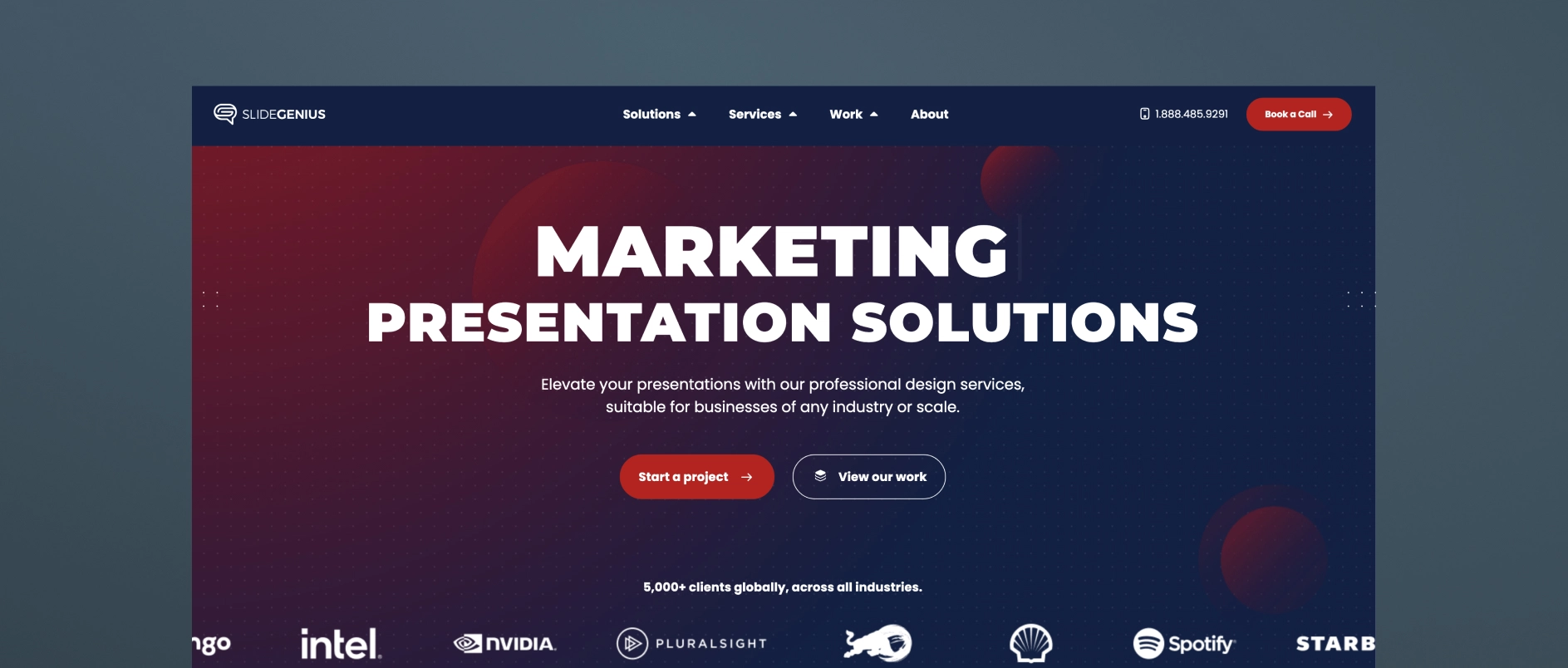
SlideGenius is a presentation design agency that produces pitch decks and sales materials across a broad range of industries. Their specialty is visual design and slide sequencing, structured around sales psychology to guide a viewer through a decision. They work with clients across sectors rather than focusing exclusively on investment managers.
Best for firms who need: a professionally designed deck produced efficiently, with a structured, repeatable process and design-forward execution.
3. Superside
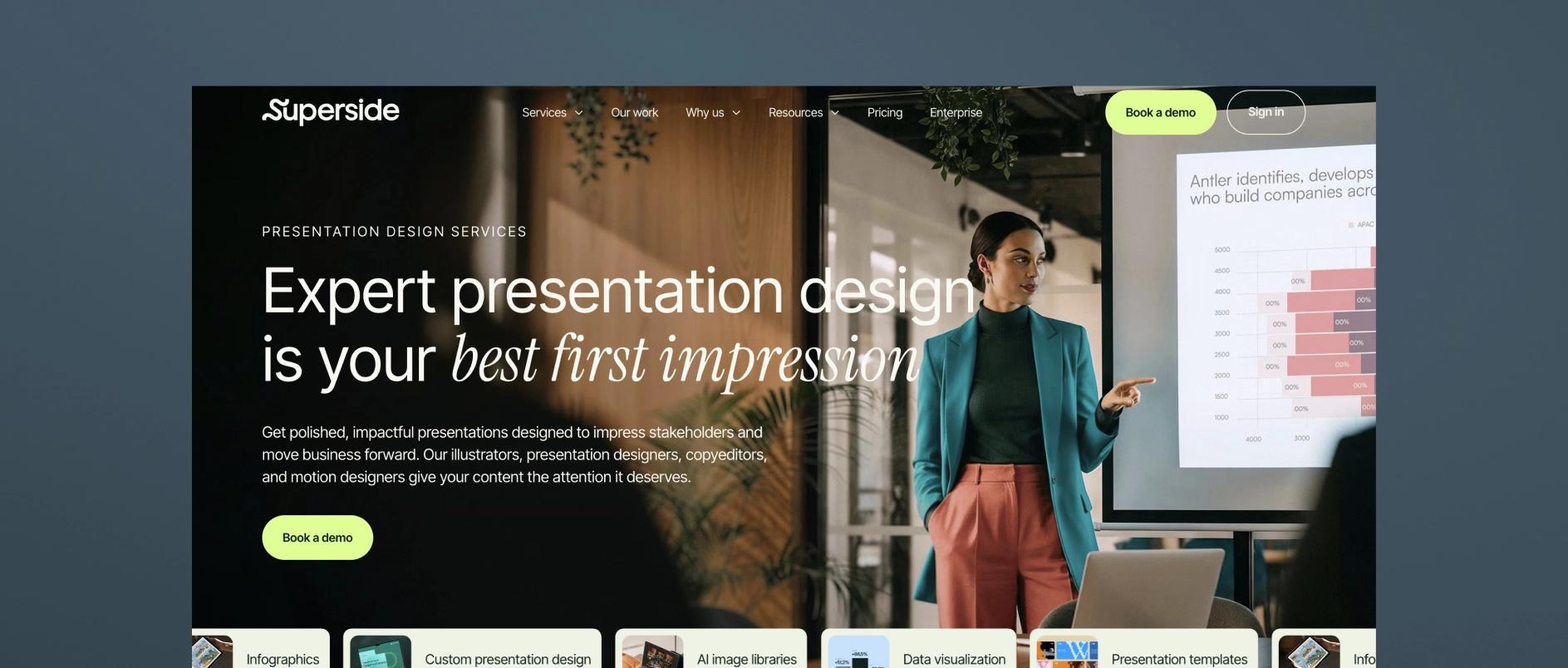
Superside is a subscription-based, “always-on” design company that provides presentation design as one of many creative services — alongside branding, video, web design, illustration, and more — for scale-up and enterprise clients across industries. Their presentation work spans templates, PowerPoint and platform-specific design, pitch decks, and sales presentations, with access to motion design, illustration, and video production layered in as needed.
Best for firms who need: fast turnaround on high-volume design requests, flexible access to a broad range of creative services under one subscription, and a scalable design bench rather than a single point of strategic counsel.
4. Williams Lea
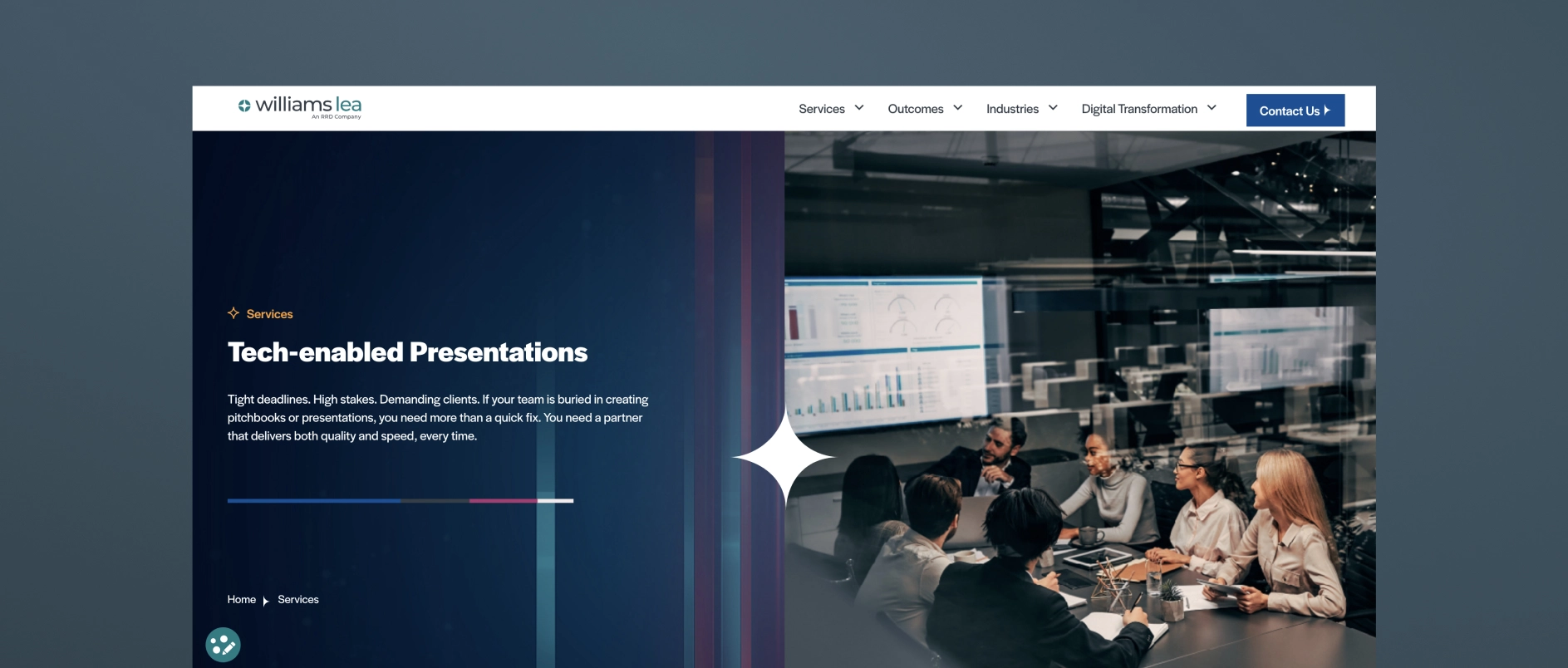
Williams Lea is a large, tech-enabled business process outsourcing (BPO) provider that offers high-volume pitchbooks and presentations as one line item alongside secretarial support, document processing, digital mail, billing support, and other back-office services. They serve financial, legal, and professional services firms specifically, and their presentation work centers on turning complex data into high-volume, tech-assisted pitchbook and PowerPoint output, often delivered under tight deadlines.
Best for firms who need: high-volume, fast-turnaround pitchbook production, execution capacity to supplement an internal team, and operational/formatting support across many other back-office functions.
5. MVP Design
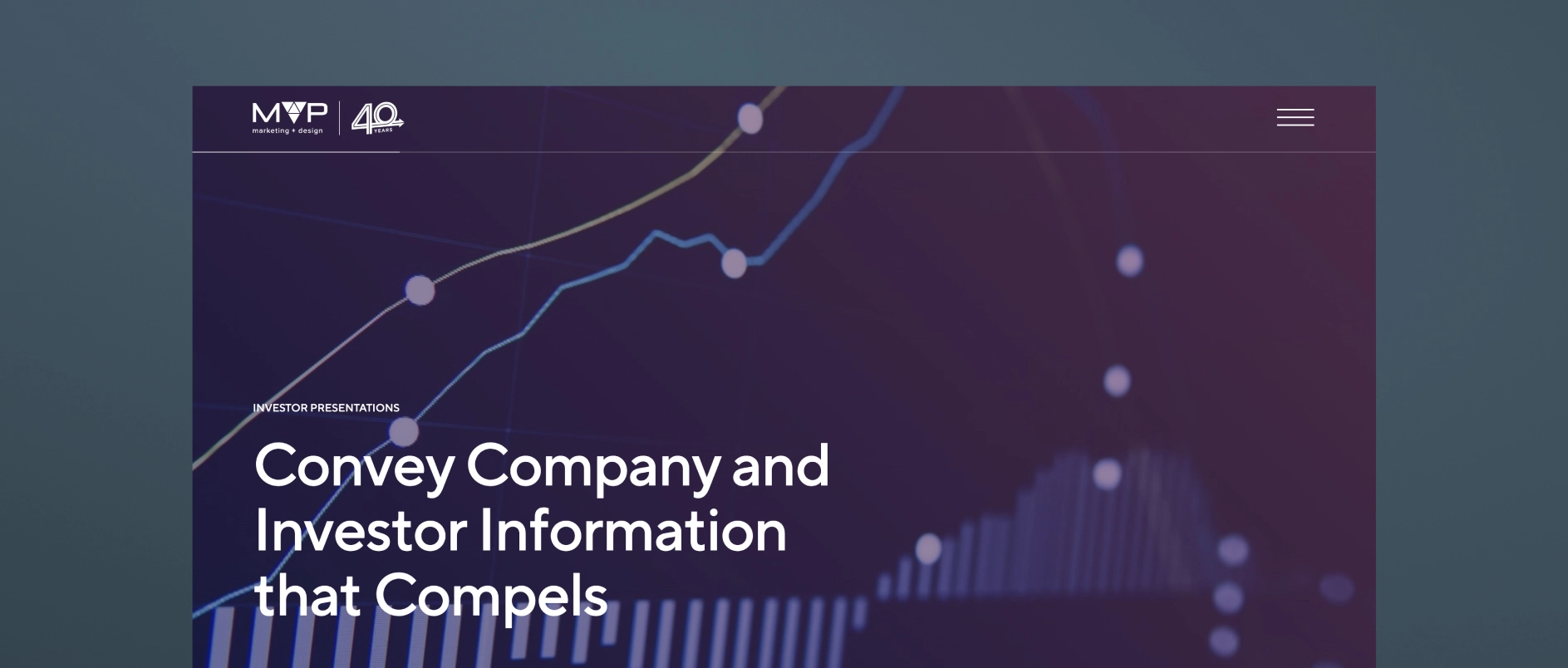
MVP (MVP Marketing + Design) is a Midwest-based marketing and design firm that works specifically with private equity, M&A, and lower-middle-market firms on investor communications. Their MVP PitchMate℠ process is built around custom investor and annual meeting pitch decks, as well as CIP (confidential information presentation) work, aiming to translate complex information into clear PowerPoint visuals.
Best for firms who need: PE/M&A-specific pitch decks, LPAC and annual meeting presentations, and a firm that pairs design execution with some sector-specific investor-communications experience.
6. Investor Creative
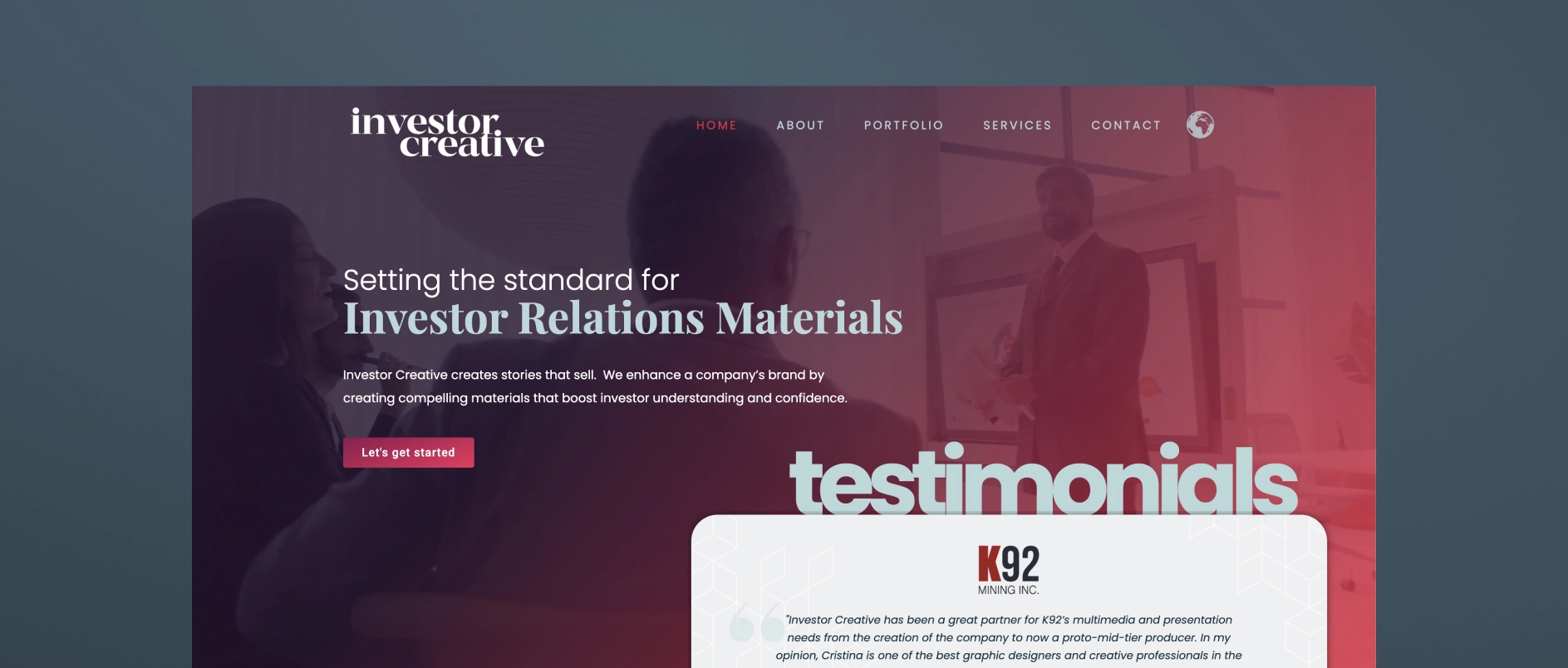
Investor Creative is a small, boutique investor relations design studio that creates presentations, websites, fact sheets, and branding materials for public and private companies. Their positioning is built around bridging the gap between a public company's limited in-house graphic capabilities and the learning curve required for a designer to understand investor appeal.
Best for firms who need: a single experienced designer who understands IR materials, presentation, and website refreshes for small-cap or junior public companies (especially resource/mining issuers), and an affordable, personal, long-term design relationship rather than a full-service agency team.
7. M'Idea Hub
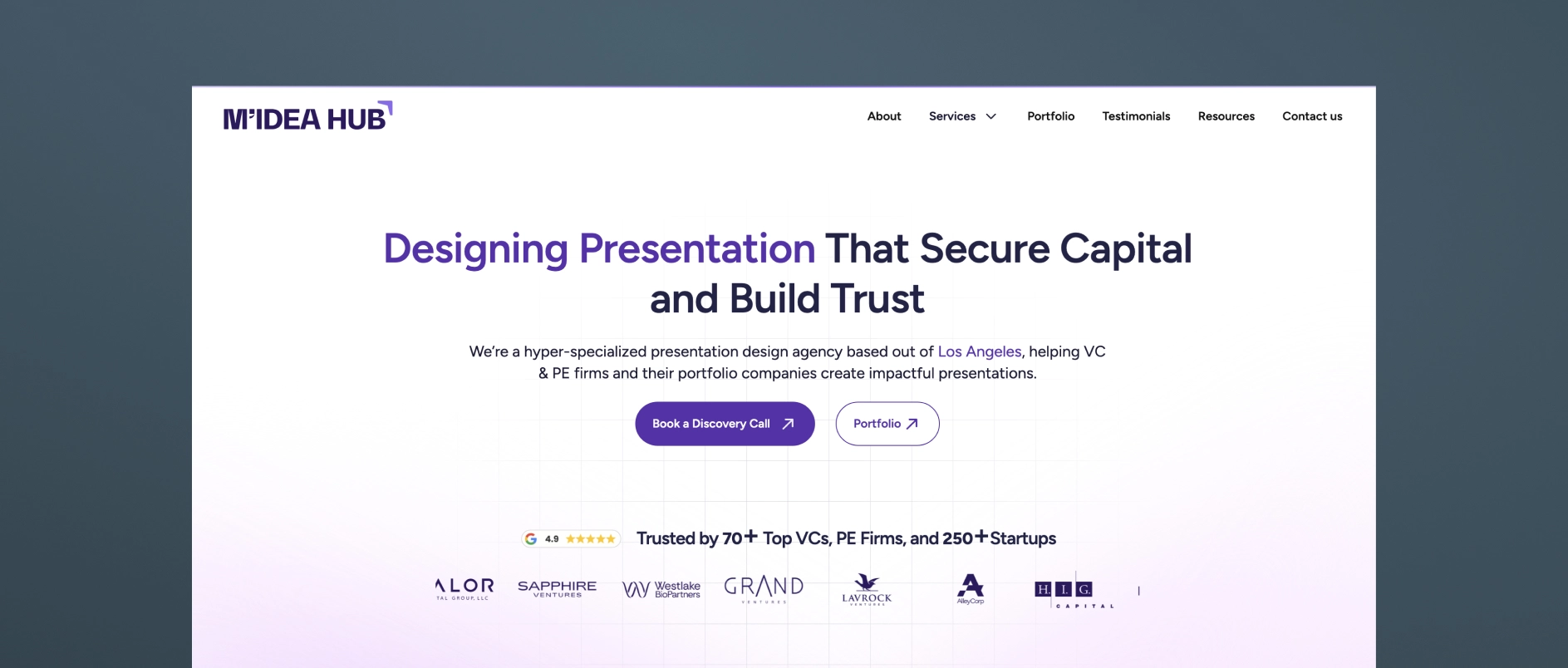
M'Idea Hub is a Los Angeles-based, boutique presentation design agency positioned specifically around VC and PE investor communications. They combine strategy, storytelling, and high-fidelity design to create fund decks, LP updates, and AGM presentations.
Best for firms who need: fund decks, LP updates, and AGM presentations for VC and PE firms that want a specialist design-and-narrative partner without a broader branding/website scope.
8. Stinson Design
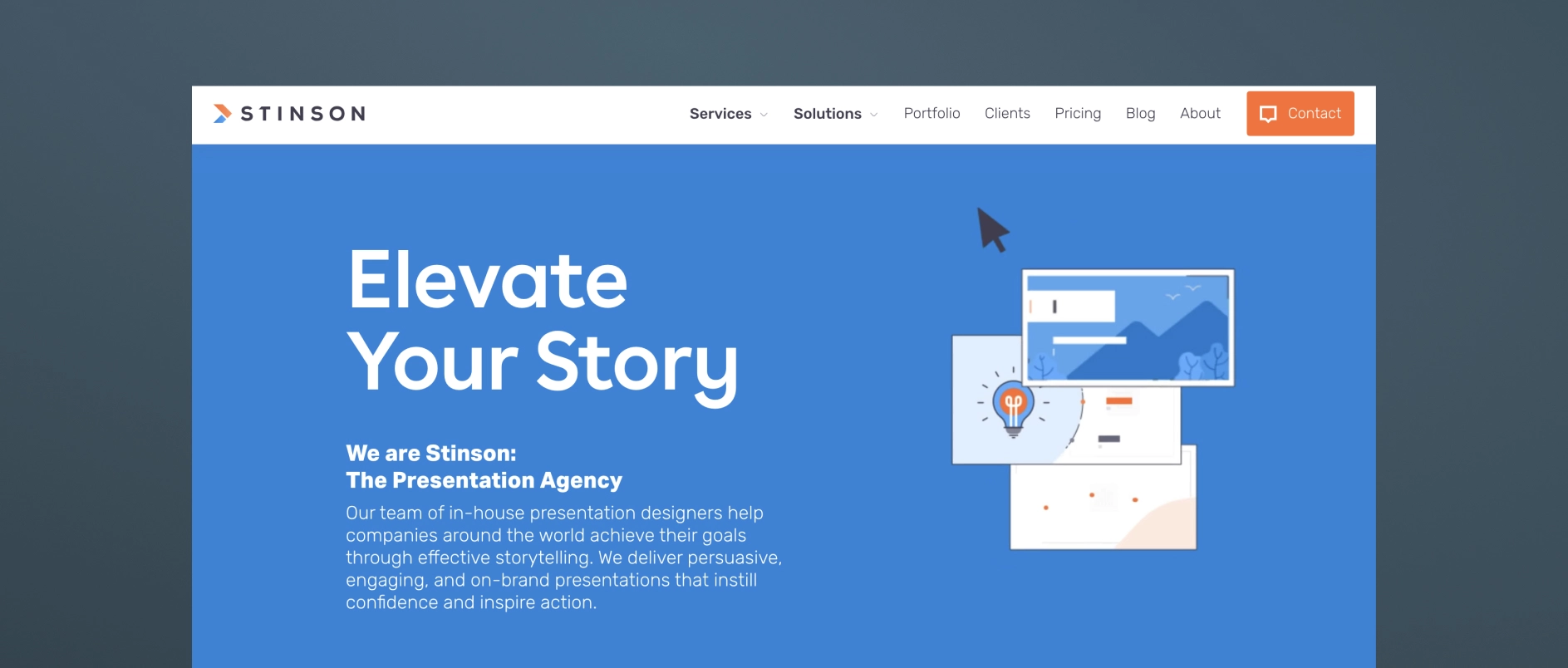
Stinson Design is a presentation design agency (Toronto-based) that has built meaningful experience in financial services and investor presentations, though it's not exclusively focused on the PE/institutional-LP niche. They've carved out a niche in investor presentations and financial storytelling, with a portfolio reflecting experience in capital markets and investment management, and clean, data-forward design suited to a financially literate, skeptical audience.
Best for firms who need: strong data-storytelling and design craft for roadshow decks, fund launch presentations, annual investor materials, or data-heavy financial analyses, from a team with real financial-sector reps but a more generalist client base overall.
9. PitchLift
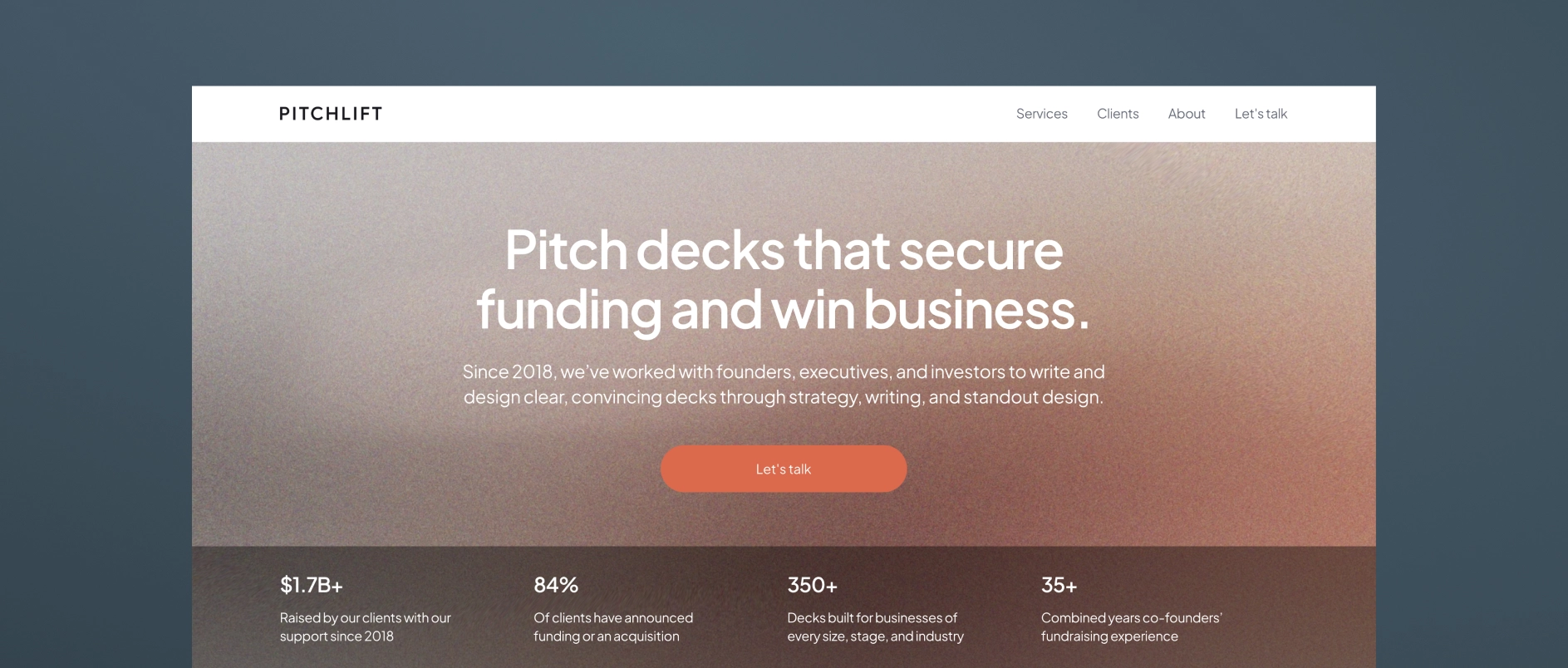
PitchLift is a small, boutique fundraising and presentation agency based in Austin and Barcelona. Their services cover graphic design, financial modeling, branding, one-pagers, and investor planning.
Best for firms who need: startups and growth-stage companies (with some enterprise/fund work) needing a lean, strategy-plus-design partner.
10. Van York Agency
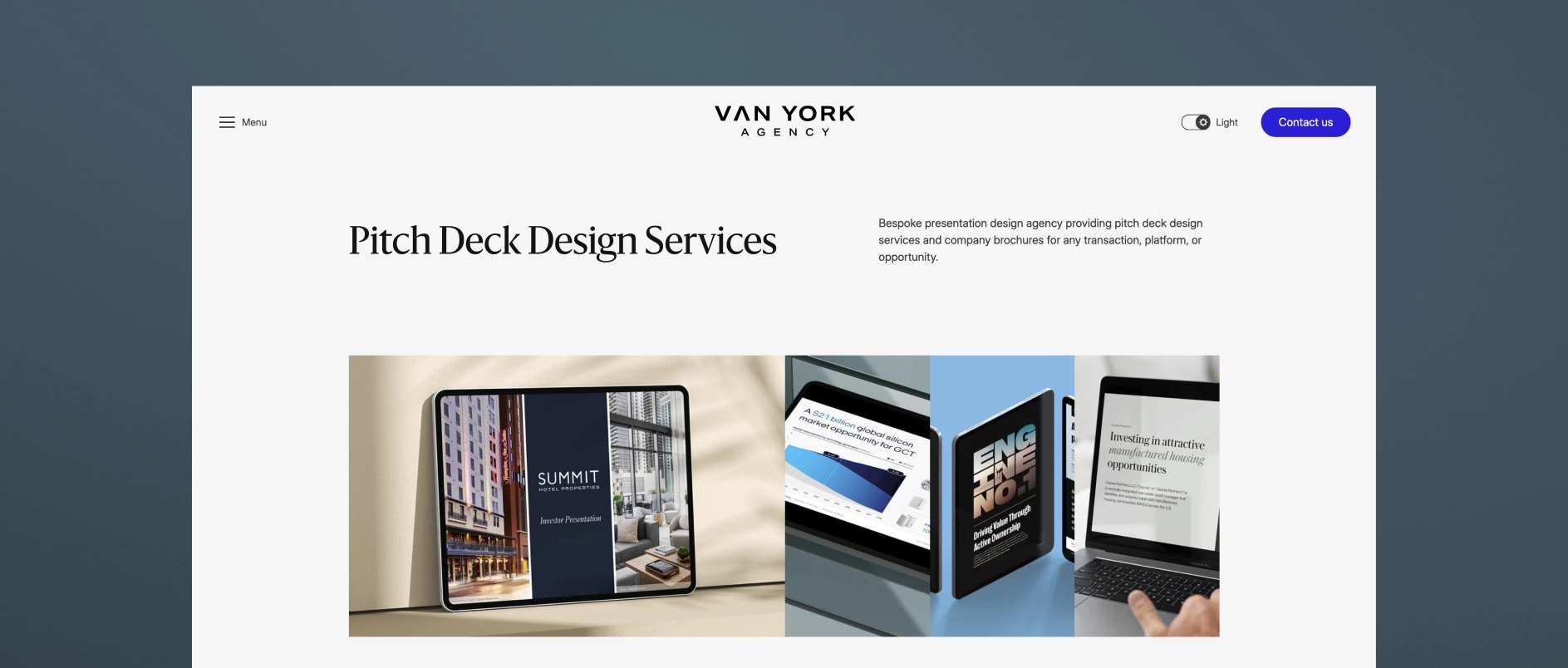
Van York is a Vancouver-based presentation and brand design agency built around end-to-end investor and B2B communications. Services span capital markets decks (IPO, SPAC, PIPE, private placement), private capital decks (seed through Series D, M&A, JV), investor relations materials (earnings, investor day, analyst day), and B2B sales/RFP decks — offering research-through-design presentation support in one shop, with fast-turnaround options.
Best for firms who need: capital markets, PE/real estate, and B2B firms needing research-through-design presentation support in one shop, with fast-turnaround options.
Darien Group works exclusively with investment management firms on brand strategy, visual identity, and digital presence. Contact us to discuss where your firm's design stands.



Fundraising cycles don't always line up neatly with fund lifecycles. Many managers return to market while the current fund is still partially deployed, its marks are early, and its best outcomes may be concentrated in a few positions. Each of those facts invites a question. The deck can either answer them directly or leave the presenter hoping they do not come up.
One founder recalled that his firm raised its second fund before the first had produced any outcomes. The fundraising environment was receptive, the investor base was largely the same, and the process was straightforward. Later raises often ask more of the materials, which is why framing an early fund deliberately is worth the effort.
Partial Deployment: Framing Pace as Discipline
A fund that is partly deployed can read two ways: as a manager waiting for the right opportunities, or as one struggling to find them. The difference is usually in the framing. One firm with a fund roughly halfway invested wanted to make sure its pace read as pricing discipline rather than inactivity. The approach we explored was to let its entry-pricing exhibit carry that message, supported by a view of active pipeline activity to show momentum.
The broader principle is to give deployment a narrative. How many opportunities did the firm review? What did it pass on, and why? What does the pipeline look like now? Answered clearly, these questions turn a percentage into evidence of selectivity.
Early Marks: Saying What They Are and What They Are Not
Early marks are a real data point, and a limited one. Presenting them with appropriate context tends to build more credibility than presenting them with enthusiasm. That means being clear about how long assets have been held, what the marks reflect, and what remains ahead.
At this stage, operating progress can often say more than valuation. One firm's current fund was running ahead of its leasing assumptions across the portfolio. That proof point showed the business plans working without asking investors to rely on interim marks alone.
Concentrated Outcomes: Showing the Pattern Behind the Results
Many strong track records owe a large share of their returns to a handful of investments. Rather than averaging that concentration away, the deck can explain what it reveals. One team found that its best results came from investments where it held a controlling position and could be most involved. At the same time, it wanted to show that it could generate good outcomes across other structures as well.
That kind of pattern is worth stating directly. Concentration framed as a repeatable approach reads very differently from concentration that investors discover on their own in the data room.
Connecting the Prior Fund and the Current One
When the current fund is early, the prior fund usually carries the realized proof. The two can work together: the prior fund shows outcomes, and the current fund shows the same approach in progress. One firm considered pairing a view of expected liquidity events in its prior fund with pipeline activity in its current one, giving the deck a sense of momentum at both ends of the cycle. Any forward-looking content like this should be carefully worded and reviewed with compliance.
Case studies are especially useful here. A current-fund investment can show the firm's playbook in action even before an exit. Placed alongside a realized prior-fund example, it shows continuity from one fund to the next.
The same continuity matters when a prior fund underperformed, and presenting an underperforming fund candidly often strengthens the case for the current one.
Framing the Fund in Motion
Raising while deploying asks the deck to tell a story that is still unfolding. The firms that do this well are not necessarily the ones with the most impressive interim numbers. They are the ones that explain clearly where the fund stands, what investors are looking at, and how today's progress connects to the record that came before.
Framed directly, an early fund becomes an opportunity to show a strategy working in real time, and a firm confident enough to describe it plainly.
Darien Group builds fundraising materials for managers raising their next fund. Learn more about our investor presentation work.


A rebrand at an investment firm rarely belongs to one person. Founders, managing partners, investor relations, operations, and sometimes the leaders of affiliated strategies or a board all have a stake in how the firm presents itself. That breadth of input is valuable. It is also one of the main reasons brand projects slow down.
In our experience, multi-stakeholder rebrands seldom stall because of the creative work itself. They stall when it's unclear who is providing input at each stage, who makes the final call, and what exactly is being decided. Settling those questions at the outset is often the most important step in the whole project.
Why the Process Matters as Much as the Output
Some brand deliverables are naturally harder to align on than others. Names, logos, and messaging statements are abstract and highly subjective, and each one invites a personal reaction. The more people involved, the more opportunities there are for reasonable differences of opinion to compound.
A clear process doesn't remove those differences. It gives them a place to be heard and resolved, so the project can keep moving toward one coherent brand rather than an average of many preferences.
Define Who Decides Before Anything Is Designed
The first conversation in a multi-stakeholder project is usually about structure, not creative. A few questions help bring that structure into focus:
- Who is in the day-to-day working group, and who leads it?
- Which decisions belong to senior leadership alone?
- Who holds a firm veto, and who offers advisory input?
- When should affiliated managers, committees, or board members be brought in?
- At which milestones will leadership be asked to formally approve the work before it moves forward?
It helps to make those roles visible from the start, both to the agency and to everyone inside the firm. When each stakeholder knows what they'll be asked to weigh in on, and when, feedback tends to arrive clearer and earlier. For most firms, the working group carries the bulk of the day-to-day effort, which is why how much time it requires is one of the questions investment managers ask most before a brand engagement.
Listen Broadly, Decide Narrowly
Early in a project, wide participation is an asset. Before anything is proposed, the goal is to understand how different people describe the firm, what they value, and where their views diverge. Hearing from a broad group at this stage costs little, and it often surfaces tensions that would otherwise appear much later.
As the project moves toward decisions, the circle should narrow. Input from many people informs the work; approval from a defined few moves it forward. Keeping those two roles distinct is one of the simplest ways to protect both the timeline and the clarity of the final brand.
Consolidate Feedback Before It Reaches the Work
How feedback travels can matter as much as what it says. A few practices tend to keep review rounds productive:
The internal owner doesn't need to be the most senior person at the firm. What matters most is that they have the standing to gather input from leadership and the trust to speak for the group.
Make Subjective Decisions Easier to Make
Abstract deliverables invite open-ended debate. A few principles help a group reach decisions with confidence:
- React to something concrete. Most people find it easier to respond to proposed language or a specific option than to define an answer from scratch.
- Evaluate against agreed criteria. When positioning is settled first, creative work can be judged on whether it expresses that positioning, rather than on individual preference.
- Show the work in context. A positioning statement seen on a homepage or in a deck is easier to assess than the same words on a blank page.
- Favor a clear direction over a compromise. Blending distinct options can dilute the clarity that made each one compelling.
Sequence Decisions From Strategy to Execution
Brand decisions build on one another. Positioning informs the visual identity, and the visual identity informs how the website, materials, and channels come together. Approving each layer before moving to the next keeps the group aligned and avoids revisiting foundational questions once production is underway.
If new questions surface along the way, it's usually worth pausing to resolve them. A disagreement settled at the strategy stage is far easier to address than one that emerges once a website is in development.
What an Experienced Partner Adds
An agency that has worked through many rebrands brings more than creative capability. It knows which questions about decision rights to ask early, where projects with many stakeholders tend to get stuck, and how to adjust as new information arrives. As an outside party, it can also hear competing perspectives without a stake in any one of them, and help the group find language everyone can stand behind.
The most successful projects treat that structure as part of the engagement itself, agreed with leadership at the outset rather than worked out along the way.
Alignment Is the Deliverable Behind the Deliverables
The visible outputs of a rebrand are a name, a logo, a website, and a set of materials. The less visible output is a leadership team that agrees on what the firm stands for and can describe it consistently. A thoughtful process, with clear roles, broad listening, and decisions made in sequence, is what produces that agreement. When it is in place, the creative work has a firm foundation, and the brand that emerges reflects the whole organization rather than whoever spoke last.
Darien Group runs rebrands for investment managers with many stakeholders at the table. Learn more about our messaging and positioning and visual brand development work.



When someone asks an AI assistant about a private equity firm, the answer rarely comes from a single page. It is pieced together from the firm's website, its press releases, third-party database profiles, news coverage, and LinkedIn. When those sources agree, the description comes out clean. When one lists an older fund size, another describes a sector focus the firm has since moved past, and a third still uses a former name, the answer tends to hedge, blend, or simply get it wrong.
Firms have long treated consistency across public touchpoints as brand hygiene. It now also shapes how a firm is described by the tools that investors, intermediaries, and management teams increasingly use in early research. The goal is to make the firm easy to describe accurately, without sanding away what makes it distinct.
How AI Tools Assemble a Description of a Firm
Generative AI tools tend to synthesize what they find from many sources rather than defer to a single authoritative page. Information that appears repeatedly, specifically, and recently is more likely to carry through. What these tools often can't do is tell which of two conflicting facts is outdated.
The chart below outlines where a firm's description typically comes from, and where it tends to drift:
Each source is reasonable on its own. Together, they can describe several slightly different firms.
That matters because AI has moved into the deal process and is changing how firms are evaluated before anyone makes contact.
Where Inconsistency Usually Creeps In
No firm sets out to be inconsistent. Drift tends to accumulate around moments of change: a new fund, a sector that has been added or retired, a team that has grown, or a strategy that has sharpened over time. Each update reaches some touchpoints and not others.
Name changes are the most visible version of this. One firm we're currently working with is changing its name after many years in the market under its original name. As one of its partners noted, the firm is set up in bank and counterparty systems around the world under the former name, and the market will need time to adjust. Much of our work has centered on helping the firm present its new identity consistently across key touchpoints. That includes a single plain-language explanation of how the current and former names relate, used consistently everywhere, and consistent attribution wherever the predecessor firm's history appears.
The aim is simple: anyone searching either name should find a clear account of a single firm, rather than two entities that look loosely related or are easily confused with similarly named firms.
Specific Language Is What Makes a Firm Describable
Generic language is hard to summarize accurately because there is little to hold onto. "A private investment firm partnering with exceptional businesses" could describe hundreds of managers. Specific language gives every reader, human or machine, something concrete to repeat.
On another recent website project, the client asked for a lean, understated site and was explicit that the firm should surface when someone searches for its investment criteria via AI tools or industry databases. Those two goals pointed in the same direction. With fewer words on the page, each one had to be more precise.
The firm's focus offered a useful example. Its sector, industrial technology, is a broad label that can mean many different things. In conversation, the team was clear that what defines its investments is less the end market than the type of business. Writing that distinction into the copy made the firm easier to find for the searches that matter, and sharper for every visitor who arrived.
Specificity and differentiation tend to reinforce each other. A firm that describes itself precisely is both easier to find and harder to confuse with anyone else.
Preserving Differentiation While Standardizing the Facts
Consistency does not mean every touchpoint should read identically. It helps to separate two layers: the facts that should never vary, and the expression that can flex by channel.
This matters most for firms with a broad mandate. A firm that looks at many sectors can still be specific about the situations it pursues and the characteristics it seeks. Anchoring the description there keeps the mandate open while giving the market and AI tools something precise to repeat.
Any figures that appear publicly, particularly AUM and fund sizes, should carry clear as-of dates and be reviewed with compliance, so updates are made deliberately rather than piecemeal.
A Practical Consistency Review
A periodic review of public touchpoints is one of the more efficient steps a firm can take for both search visibility and credibility. A useful starting list:
- Website: Do the homepage, strategy, team, and portfolio pages describe the firm the same way?
- Press boilerplate: Is the current "About" paragraph used in every new release, and does it match the website?
- LinkedIn: Do the company page and team profiles reflect current titles, the current name, and the current strategy language?
- Third-party databases: Has the firm claimed and updated its profiles where possible?
- Older press releases and news: Is there context on the website, such as a brief note on a former name, that helps readers reconcile older references?
A firm doesn't need to fix every legacy reference at once. Aligning the sources it controls and clearly bridging the ones it doesn't usually go a long way.
One Firm, Described the Same Way Everywhere
Investors, intermediaries, and their research tools are forming a picture of a firm long before the first meeting. A firm can't control every source that picture draws on, but it can make sure its own sources agree, and that what they say is specific enough to be repeated accurately.
The firms that are easiest to describe aren't the ones that say the most. They're the ones who have decided exactly what they want to be known for, and say it the same way wherever someone looks.
Darien Group helps investment managers make their firms easy to find and describe accurately, in search and in AI tools. Learn more about our SEO and AI visibility work, or read our best practices for private equity websites.



An annual general meeting, or AGM, is a private equity or investment management firm's yearly opportunity to update its investors, whether in person or virtually. Where a pitch deck often has to make the firm's case on its own, an AGM deck is presented live, with partners walking investors through the year and the opportunities ahead. Yet many AGM decks are written as though they will be read without a presenter, with every point spelled out on the slide.
The most effective AGM presentations are designed for the room. They complement the speaker, highlight what matters most, and keep investors engaged from one section to the next.
Two Decks, Two Jobs
A pitch deck usually starts in a meeting, with a prospective investor getting to know the firm for the first time. It is often shared before or after that conversation for a closer read, and from there it can travel to colleagues, investment committees, and advisors who were never in the room. Without the team there to explain it, slides can easily be read out of context. As a result, a pitch deck has to hold up on its own, with a clear narrative arc and enough detail to support every point.
An AGM deck needs a narrative arc too, but its circumstances are different. Partners present it live, and in many cases it is not shared afterward. The speaker carries the story, and the slides are there to complement it: highlighting the most important points, giving the audience something to anchor to, and keeping the presentation engaging.
When an AGM deck is built like a pitch deck, the two can end up competing. Investors read ahead while the presenter is still on the first point, or the presenter reads the slide aloud because it already says everything. Either way, attention splits, and the most valuable part of the meeting, hearing directly from the people managing investors' capital, gets less room than it deserves.
Letting the Speaker Carry the Story
In a live setting, the speaker is the primary channel and the slide is the visual anchor. That shift opens up a different approach to content. A slide can lead with a single clear takeaway as its headline, supported by a visual or a few key figures, while the presenter supplies the nuance, the context, and the story behind the numbers.
The detail does not disappear. It moves into the speaker's remarks, where it can be delivered with emphasis and adjusted to the room. Many firms find that this gives partners more freedom to speak naturally and to share the perspective investors often value most: how the team is thinking about the portfolio and why.
Designing for a Live Audience
Design plays a larger role at an AGM than many firms expect. A slide on a screen across a ballroom, or on a livestream for investors joining remotely, only has a moment to make its point. Generous white space, larger type, and a clear visual hierarchy help key messages land from any seat.
Visuals do much of the work. A chart simplified to the one trend that matters, a key figure set large on the page, or photography of portfolio companies and assets can communicate in a glance what a paragraph would take a minute to read. When a slide feels light and open, the audience can absorb it quickly and turn their attention back to the speaker.
Consistency matters here as well. When several partners present, a shared design system keeps the day feeling cohesive, so investors are following one story across many voices.
“Good AGM design starts with knowing what actually deserves the audience’s attention. Thoughtful use of white space, scale, and visual consistency makes each slide easy to follow, so investors can quickly grasp the key point and stay engaged with the speaker.“
Anastasiia Kharytonova
Director of Design & Production at Darien Group
More Slides, Less on Each
One practical result of this approach is that an AGM deck is often longer than a pitch deck in slide count, even while carrying less content overall. That can feel counterintuitive, but it reflects how live presentations work. A presenter moving through several focused slides keeps the room engaged more easily than one who lingers on a single dense page for several minutes.
Each slide can hold one idea, presented clearly, and the rhythm of the presentation moves with the speaker. The result tends to feel lighter and more energetic, even across a full day of content.
The chart below outlines how the two formats typically differ:
These are general tendencies rather than rules, and every firm will find its own balance. The underlying idea is consistent: the format should match how the audience will experience it.
When the Deck Does Travel
Some firms do share materials after the AGM, whether with investors who could not attend or as part of their regular reporting. That does not have to change how the live presentation is built. If additional context would be helpful, firms can follow up with materials designed specifically for offline review, or, for firms that record the meeting, share the recording so the slides are seen alongside the speaker.
Designing for the room first, and adding context afterward where it is needed, keeps the focus on the live experience that the AGM is built around.
Decks that need to work in both settings follow the same principles as investor presentations built to travel in and out of the room.
Bringing the Presentation Together
Translating a year of work into a presentation that feels clear and engaging is no small task, especially during one of the busiest stretches of the year. Darien Group has worked with private equity and real estate investment firms on AGM presentations of different sizes and formats, helping distill dense source material into presentation-ready slides, bring consistency across multiple presenters, and design visuals that make complex information easy to follow from across the room.
An outside partner can also help a team see the deck as the audience will, identifying where a slide is doing too much and where a visual could replace a paragraph. That perspective can be especially useful when the content has been built up over many weeks and through many hands.
Closing Thought
At an AGM, investors hear directly from the firm’s team, in their own words. The deck behind them works best when it makes room for that, offering a clear visual anchor while the speakers bring the year, and what comes next, to life.
The right balance between slide and speaker will vary by firm, by presenter, and by year. What carries across is a simple idea: an AGM deck is one half of a live conversation, and it does its best work when it leaves the other half to the people in the room.
Darien Group designs and produces annual meeting materials for private equity and real estate managers. See how we approach AGM support, or read our guide to structuring and designing annual meeting materials.
