
.jpg)
Side Letters
Side Letters is a collection of essays, research, and analysis on how investment firms communicate with investors, management teams, and transaction partners. The focus is practical: how firms articulate value, build credibility, and navigate increasingly complex evaluation environments.

Featured Videos





Emerging managers often underestimate the importance of their website not because they’re naïve, but because they assume LPs will begin forming judgments during the meeting. LPs don’t operate that way. The first impression happens before the relationship begins — specifically, at the moment an LP types your name into a browser. That visit is not just a glance. It’s a micro-evaluation of your readiness to step into the institutional world.
And because emerging managers haven’t been in the market long — Fund I, Fund II, a newly announced strategy with a small team — the name itself carries no history. No reputation precedes you. The website becomes the origin point of your institutional story. LPs know this, and they treat it as such.
When I talk about digital presence with early-stage managers, I often describe the internet as a galaxy: billions of stars, clusters, gravitational pulls. A brand that has existed for 30 years already has its galaxy — its residues, artifacts, historical clutter. A new manager has none of that. You get to launch a fresh star system. LPs are looking to see whether the constellation you’re building makes sense.
1. LPs Are Not Looking for Perfection — They’re Looking for Readiness
LPs don’t judge emerging managers the way emerging managers judge themselves. The GP is often thinking about what the site “says.” LPs are scanning for what the site implies.
Questions they ask intuitively:
- Does this firm understand its category?
- Does the digital presentation reflect how serious the strategy is supposed to be?
- Does this feel like the starting point of something real?
A polished site doesn’t guarantee readiness. But a sloppy one almost always signals unreadiness. LPs are evaluating whether you’ve made intentional choices — not extravagant ones, but thoughtful ones. That alone separates you from most early-stage peers.
This is the first moment LPs decide whether a manager is “real” or “not yet.”
2. Your Website Creates the Emotional Frame for the Entire Relationship
The website is almost always the first emotional contact point an LP has with a new manager. It tells them:
- whether you are confident,
- whether you understand your own story,
- whether you are leaning into your newness or hiding from it,
- and whether there is actually a strategy worth hearing.
Emerging managers often forget how powerful newness is. LPs don’t meet many managers in their twenties or thirties who are building funds. And when they do, they want that energy. They want to believe they’re seeing the beginning of something that could scale. That optimism is an asset — if the website uses it thoughtfully. A conservative, too-traditional digital presentation erases one of the few natural advantages an emerging manager possesses.
In the arts, the most exciting filmmakers and musicians are rarely the oldest ones. Markets behave similarly. When a manager’s digital identity communicates intelligence, discipline, and freshness simultaneously, LPs tune in fast.
3. Single-Scroll Sites Work Because They Respect the LP’s Attention
For emerging managers, a single-scroll website is not a compromise. It’s often the correct architecture. Smaller teams, minimal track records, and early-stage stories rarely justify multipage sprawl. LPs prefer clarity over volume, and coherence over breadth.
A single-scroll site:
- forces narrative discipline,
- prevents empty pages (“Portfolio,” “Team”) from signaling fragility,
- organizes the story in a digestible sequence, and
- conveys confidence rather than apology.
LPs don’t penalize smallness. They penalize sloppiness, inconsistency, and premature scaling.
A well-done single-scroll site says, “We know exactly who we are at this stage.”
That is a very compelling signal.
4. The Case Against Cheap Websites (and Why LPs Notice)
(One of the two posts where this argument will appear)
Many emerging managers go the inexpensive route at the beginning — a $2,000 template site, a freelancer overseas, or a Squarespace build put together between other tasks. Technically, this can work. But strategically, it introduces four problems that LPs pick up immediately:
- You’re delaying the introspection that the real website forces.
A proper site requires clarity: What is our category? What do we believe? What do we want people to remember? Cheap sites let you dodge that work — and LPs can tell. - You’re going to rebuild it in 12–18 months anyway.
Why race with a sprained ankle when you could start healthy? - You squander dozens of early impressions.
In Fund I, you don’t have the luxury of B-minus impressions. One strong early impression can change a firm’s trajectory. - The founder ends up doing the work.
No emerging manager has extra time. Trying to micromanage a designer who doesn’t understand institutional capital is a bad use of a scarce resource.
Cheap doesn’t always mean bad. But cheap almost always means unfinished. LPs can feel that immediately.
5. LPs Don’t Just “See” the Website — They Infer the Organization Behind It
When LPs look at your website, they aren’t judging your taste. They’re judging your discipline. A website is the first operational artifact LPs encounter. They assume:
- organized site → organized fund
- coherent design → coherent underwriting
- clear copy → clear thinking
- sloppy execution → sloppy diligence
- mismatched elements → emerging team not yet aligned
None of these correlations are perfect. But LPs don’t need perfect correlations. They need enough signal to decide whether it’s worth spending time.
Closing Thought
Emerging managers start at a structural disadvantage: limited track record, small team, thin footprint. The website is one of the only tools that can reverse that disadvantage quickly. Not by pretending to be a billion-dollar platform, but by demonstrating clarity, narrative discipline, and readiness.
Before LPs hear your strategy, they experience your digital identity. And in Fund I fundraising, that difference — between the GP who treats the website as part of the institutional story and the GP who treats it as a formality — often determines who advances to the next conversation.


Emerging managers often assume their digital presence is a supporting detail — a credibility checkbox, a place to house the team bios and the contact form, something LPs will glance at briefly before the real conversation begins. In reality, LPs make meaning out of digital signals long before they make meaning out of strategy. For most emerging managers, the website, the footprint around it, and even small digital behaviors function as a quiet pre-meeting filter. LPs start forming judgments before the first Zoom call is scheduled.
This is not because LPs are superficial. It is because they are overloaded. Most institutional allocators are tracking dozens of managers at any given time, fielding dozens more inbound, and monitoring a saturated pipeline where the differences between strategies are often subtle. They cannot begin each relationship from zero. They use digital cues to determine whether a manager is ready for institutional conversation — or whether the GP still has work to do.
Emerging managers regularly underestimate how much of the “legitimacy gap” is closed or widened before they ever speak.
1. LPs Judge the Website Far Earlier and More Harshly Than Managers Expect
When an LP first hears your name — from a warm intro, a conference, a placement agent, or a colleague — they do the same thing everyone else does: they search you. The website is often the moment where the LP decides whether they are dealing with an institutional player or a first-time founder still finding their footing.
The website’s job is not to impress. It is to reduce uncertainty. LPs are looking for signals that you understand where you are in your institutional arc: clear strategy language, mature design restraint, coherent structure, and clean articulation of the category. Anything that feels improvised, inconsistent, or overly promotional triggers doubt. LPs don’t need you to be a billion-dollar platform, but they need to see signs of discipline.
Among emerging managers, the most common misstep is assuming the website is “good enough” because it looks modern. LPs don’t evaluate modernity. They evaluate coherence.
2. Tone Matters — Even When You Think It Doesn’t
LPs read tone before they absorb content. A website that leans too heavily on marketing language (“world-class deal flow,” “unparalleled access,” “industry-leading expertise”) suggests the manager is trying to make up for a lack of substance. A website that feels like a real estate developer’s landing page suggests transactional orientation rather than investment discipline. A website that reads as overly academic or jargon-heavy suggests the GP might be clearer in their head than in their communication.
Tone is not decoration. It tells LPs whether the manager communicates at the altitude institutional investors expect. Emerging managers often reveal more than they intend through tone: their anxieties, their need for validation, or their attempts to sound “institutional” rather than being institutional.
Tone is a psychological tell. LPs are very good at reading it.
3. Digital Behavior Signals Operational Maturity
Digital presence isn’t limited to the website. LPs form impressions from:
- whether bios are complete and up to date
- whether updates are posted consistently or sporadically
- whether fund materials feel coordinated
- whether email signatures match the website’s tone
- whether the firm shares insights or only transactional announcements
These are small signals, but they shape the LP’s sense of whether the GP is building a durable organization or improvising around the edges.
For emerging managers, inconsistency carries a disproportionate cost. LPs assume inconsistency in digital presentation may indicate inconsistency in process. The opposite is also true: even modest digital discipline can signal that the GP is thoughtful, prepared, and capable of building institutional trust over time.
Digital behavior is the operational equivalent of body language.
4. LPs Look for Patterns — Not Perfection
Emerging managers sometimes worry that their website is not on par with established funds. The truth is that LPs don’t expect perfection from a Fund I. They expect pattern recognition. They are looking for whether the manager’s words, materials, and digital presence all support the same thesis. Does the strategy described in the deck match the strategy described online? Do the bios reinforce the specialization the pitchbook emphasizes? Does the visual identity feel like it belongs to the category the GP claims?
When these patterns align, LPs assume the GP thinks clearly and is building something real. When the patterns clash, LPs assume the opposite.
This is why digital presence is not about impressiveness. It is about congruence.
5. The Subtle Signals That LPs Pick Up Instantly
LPs rarely articulate these, but in practice they react strongly to:
- websites with mismatched visual languages
- pitchbooks that look like they were assembled in pieces
- founders who use different terminology on their site than in their deck
- firms whose About section could describe any other emerging manager
- strategies that feel hedge-like in writing but private equity-like in design
- overly clever taglines or design flourishes that feel out of place
None of these signals prove that a GP is unprepared. But together, they shape the LP’s subconscious impression. Emerging managers often think these details are trivial. LPs treat them as evidence.
The design system around your strategy is not judged aesthetically — it is judged psychologically.
Closing Thought
Digital presence is the first chapter of your institutional story. Emerging managers often imagine that LP conviction is built through meetings, decks, diligence, and reference checks. In reality, LP conviction begins much earlier — in the 30 seconds they spend on your website before deciding whether to schedule the meeting at all.
Digital behavior is not an afterthought. It is the first impression, the early filter, and often the difference between an LP leaning in or moving on. Emerging managers who treat it as part of their narrative, rather than the packaging around it, close the legitimacy gap faster than those who don’t.



A clearer standard is emerging in real estate. The strongest websites today share a set of qualities that communicate maturity, focus, and confidence, regardless of strategy or scale.
Over the past several years, real estate websites have begun shifting toward a more institutional presentation. This change is visible across a wide range of firms, from global platforms like Blackstone, Brookfield, KKR, and Carlyle to single-strategy groups and diversified investment managers. Despite substantial differences in size, structure, and geographic footprint, many of these sites now rely on similar principles that make their narratives easier to understand and more effective to navigate.
This reflects a broader shift in how modern audiences evaluate real estate platforms. For investors, advisors, consultants, and intermediaries, the website is often where early impressions take shape — impressions about strategic clarity, organizational maturity, and the firm’s ability to communicate its identity with confidence.
A site does not need to be complex to be compelling. It simply needs to help visitors understand what matters most and where to find more detail.
A few themes define this emerging standard.
1. Strategy That Becomes Clear Early
A consistent pattern across the category today is the emphasis on helping visitors understand the platform early. Many multi-strategy firms with a broad geographic reach, including groups like Blackstone, Brookfield, and KKR, now begin their digital narrative with a straightforward orientation to the overall platform before introducing more in-depth or specialized content.
These early cues help visitors interpret what they are seeing. Real estate platforms can be structurally complex. Clear framing reduces friction and makes it easier to understand how investment approaches, asset types, and markets fit together.
For example, GEM Realty Capital’s website, produced in partnership with Darien Group, clearly introduces the firm’s stance and guides visitors to deeper content at their own pace.
(See case study: https://www.dariengroup.com/cases/gem-realty-capital)
Clear strategy framing isn’t about simplifying nuance. It is about providing orientation so visitors know where they are within the story.
2. Visual Restraint That Supports the Narrative
Another notable trend is the adoption of more intentional and restrained visual systems. Unlike earlier generations of real estate websites, which often relied heavily on property galleries, many contemporary sites use imagery sparingly and with purpose.
This can include:
- architectural or structural abstraction
- selective and carefully chosen asset photography
- calm, consistent color palettes
- layouts that create visual breathing room
These choices reduce unintended signaling. A single property image can imply a specific risk profile, asset type, or geographic emphasis that may not reflect the broader platform. Visual restraint avoids this and keeps attention on the underlying strategy and team.
This shift is evident across firms of all scales. The emphasis is not on minimalism, but on clarity.
“Visual restraint isn’t about minimalism — it’s about directing attention. When imagery is used intentionally, with breathing room and consistency, the brand supports the narrative instead of competing with it. A single property photo can send unintended signals about risk or strategy, so thoughtful abstraction and selective photography help keep the focus on what truly matters: the investment logic and the team behind it.”— Anastasiia Kharytonova, Head of Design at Darien Group
3. Information Hierarchy That Supports Understanding
Information hierarchy has become one of the clearest markers of an institutional-grade website. Rather than presenting all information at once, strong websites guide visitors through a logical sequence that mirrors how institutional audiences evaluate real estate platforms.
Common traits include:
- high-level framing at the outset
- a clean transition into deeper details
- clear page-level roles
- navigation that reinforces the organization of information
Platforms with broad real estate businesses, spanning multiple vehicles, markets, or asset types, often rely on this hierarchy to make large amounts of content accessible. More specialized firms use it to communicate discipline and coherence.
Effective hierarchy signals the firm’s underlying approach to organization and communication.
4. Team Presentation That Builds Immediate Credibility
Team presentation across real estate websites has also become more consistent and structured. Visitors expect to understand who leads the platform, who drives execution, and how experience is allocated across roles.
Strong team sections typically feature:
- uniform headshot presentation
- succinct but meaningful bios
- clear articulation of roles and responsibilities
- thoughtful sequencing of seniority or function
Because operating judgment and execution discipline directly influence real estate outcomes, a well-structured team section communicates maturity without needing to state it explicitly.
5. Thoughtful Segmentation of Investment Approaches
Many real estate platforms manage multiple strategies or verticals. Websites now play a larger role in helping visitors understand these components without introducing confusion.
Diversified firms often segment their approaches by vehicle type, market orientation, or investment style. More specialized managers use segmentation to differentiate between complementary strategies within a unified platform.
Regardless of scale, thoughtful segmentation helps visitors understand how the firm is organized and how its various activities relate to one another. It clarifies not only what the platform invests in, but how its pieces fit together in practice.
A More Intentional Standard for Real Estate Websites
The rise of institutional-grade websites reflects a broader shift in how real estate firms communicate. Clear strategy framing, visual restraint, thoughtful hierarchy, strong team presentation, and intentional segmentation all contribute to digital identities that feel coherent and grounded.
These elements do not replace the depth of a meeting or a diligence review. But they make it easier for the rest of the story to land.
For firms of every scale, the opportunity is the same: a deliberate and disciplined digital presence strengthens the narrative behind the investment platform.



How thesis-forward, portfolio-forward, and platform-forward architectures shape investor comprehension
A real estate manager’s website is often the first extended interaction an allocator, advisor, or prospective partner has with the platform. It is also one of the few brand touchpoints that must serve multiple audiences simultaneously: investment professionals, intermediaries, potential recruits, and sometimes retail investors, depending on the product set.
Across the industry, three website structures appear consistently because they help users understand who the manager is, what they do, and how to navigate the information. While each structure has strengths, their effectiveness depends heavily on strategy breadth, product complexity, and the firm’s communication priorities.
At DG, we see the three core architectures, not because firms are imitating one another, but because these formats tend to improve clarity and user experience.
1. Thesis-Forward Design
Best for managers with a clear investment philosophy or a distinctive point of view
A thesis-forward website places the firm’s worldview at the center of the experience. Visitors encounter a clearly articulated approach to the market, often supported by cycle-aware reasoning, targeted sector perspectives, or a defined sourcing framework.
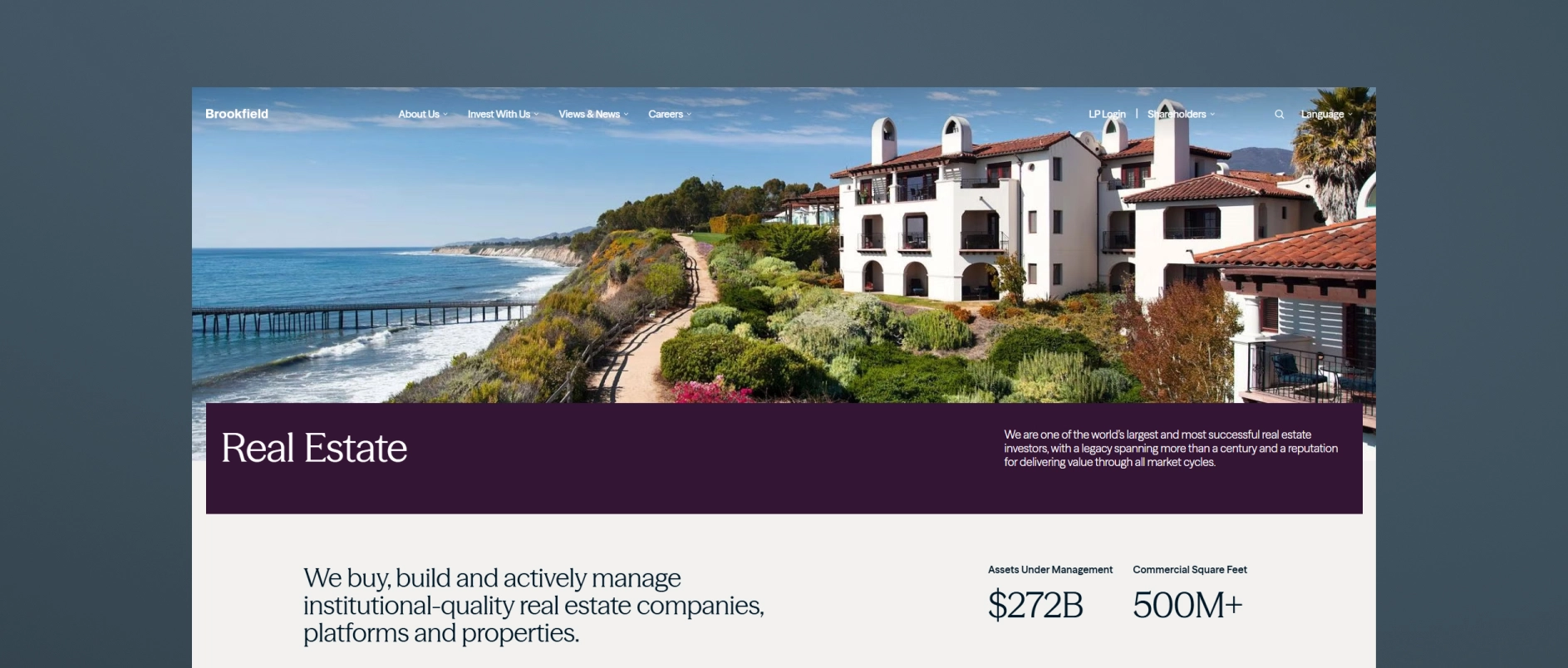
This structure is most effective for:
- Sector-specialist managers
- Emerging managers seeking early differentiation
- Strategies that rely on a proprietary lens or operating insight
- Firms where narrative clarity is core to the value proposition
- Managers with diverse strategies that can be difficult to relate to one another
Why it works
A thesis-forward site gives users immediate orientation: what the manager believes about the market and why their approach makes sense right now. For allocators who evaluate strategies through the lens of fit and coherence, this format helps establish context before details.
What to watch for
Because the thesis sits front-and-center, it must be well-structured and measured, avoiding overly declarative market statements. Retail-facing managers, in particular, benefit from balancing thought leadership with plain-language explanation.
2. Portfolio-Forward Design
Best for managers whose track record, asset examples, or execution capabilities are the primary differentiators
Portfolio-forward websites surface real projects early, not to showcase volume, but to contextualize how the strategy works in practice. The “portfolio” becomes the interpretive tool that helps visitors understand markets, risk posture, and operating capabilities.

This structure is most effective for:
- Vertically integrated or operator-oriented platforms
- Firms with meaningful asset diversity
- Strategies where real-world examples clarify the thesis more than narrative alone
Why it works
For some strategies, especially value-creation or development-heavy approaches, seeing selected projects helps users grasp scale, geography, and execution style more clearly than text descriptions.
The strongest implementations avoid presenting large photo galleries; instead, they combine:
- high-level asset cards,
- abbreviated business plans,
- standardized metrics (e.g., square footage, use type, region), and
- links to deeper strategy pages.
What to watch for
Portfolio-forward design requires disciplined curation. Too many projects, inconsistent photography, or large variances in detail can create noise. Retail-facing programs also need to ensure disclosures accompany any performance references appropriately, often influencing layout.
3. Platform-Forward Design
Best for multi-strategy managers or firms with complex distribution channels
Platform-forward websites organize the experience around the structure of the firm itself: its teams, product vehicles, capabilities, and operating subsidiaries or affiliates. This format acts as a directory, helping users understand where they should navigate based on their needs.
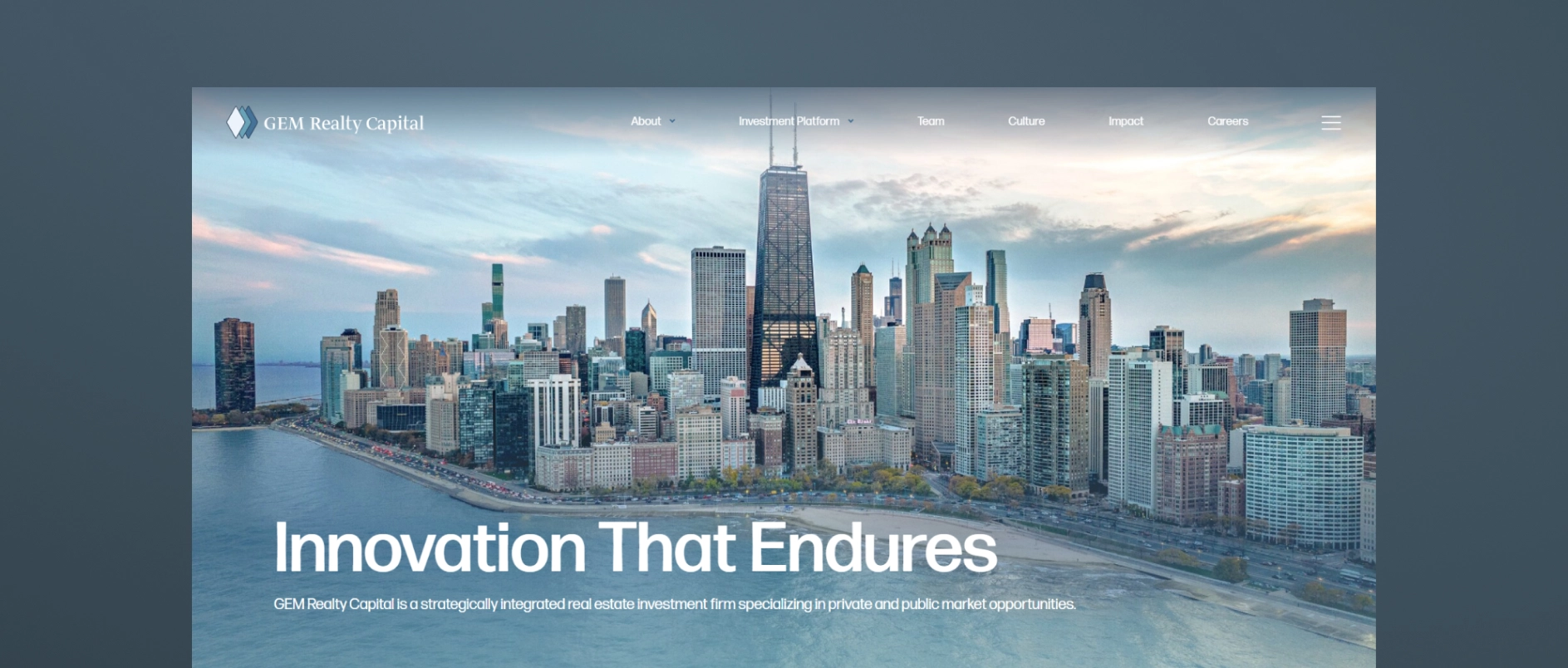
This structure is most effective for:
- Managers with institutional and wealth-channel products
- Firms offering multiple strategies (core, income, development, opportunistic, sector vehicles)
- Large organizations where team, scale, or infrastructure is a primary signal of readiness
Why it works
Platform-forward sites help visitors self-select: institutional LPs may head toward strategy pages, advisors may navigate toward product microsites, and prospective talent may go to careers or culture pages. This format supports clear segmentation without complexity.
Public examples, including large diversified real estate firms, often use this model because it scales well across product types and allows microsites to sit cleanly alongside parent-brand pages.
What to watch for
Platform-forward structures depend heavily on navigation clarity. Without intuitive menus, users may feel uncertain about where to begin. For wealth-channel products, creating a clear “Advisor Resources” path or standalone microsites avoids crowding the institutional narrative.
How to Choose the Right Structure
Align the website architecture to strategy complexity, audience mix, and communication goals
Choosing among these three models is less about preference and more about determining which architecture helps an audience understand the firm with the least friction.
Use Thesis-Forward when:
- The differentiator is how you think, not how many strategies you offer
- You are an emerging manager or a sector specialist
- Your thesis provides meaningful context for interpreting performance or portfolio decisions
Use Portfolio-Forward when:
- Real examples illustrate the strategy better than abstract explanation
- You want to highlight vertical integration or operating capability
- The assets themselves help clarify scale, market focus, or execution style
Use Platform-Forward when:
- You need to serve multiple audiences with different needs
- Your offerings span institutional LPs, advisors, and/or retail investors
- Complex products require separate microsites or tailored disclosure frameworks
For many firms, hybrid models work well. For example, a thesis-forward homepage paired with a platform-forward navigation bar, or a platform-forward main site supplemented by product-specific microsites.
What matters most is that the structure supports, rather than complicates, the story. An allocator, advisor, or investor should understand where to go and what matters within moments.
Closing Thought
A real estate manager’s website is a structural expression of the brand. The right architecture helps users grasp the strategy’s intent, the platform’s capabilities, and the path to deeper engagement. The wrong one adds friction before the strategy is ever considered.
By choosing a design model aligned with strategy complexity and communication priorities, managers create a clearer narrative environment where their strengths can be understood quickly and responsibly.


Among early-stage investment firms, one topic often discussed quietly but rarely articulated clearly is how to position a capital base that isn’t predominantly institutional. “Non-institutional capital” can refer to family capital, corporate capital, multigenerational ownership, strategic partners, or a single sponsoring entity. These structures vary widely, but they often share a defining attribute: flexibility. And when framed well, flexibility becomes one of the most compelling parts of a firm’s identity.
The challenge is not a lack of credibility. The challenge is that these structures do not come prepackaged with a familiar narrative. Institutional capital has an established vernacular. Non-institutional capital requires teams to express its strengths more intentionally. That effort, in itself, can become a strategic advantage.
The opportunity for early-stage managers is to articulate how their capital structure supports thoughtful, steady, and well-aligned investing.
1. Begin With What the Capital Base Enables, Not What It Is
Descriptions of capital composition rarely resonate on their own. What tends to matter more is the way those structures shape the firm’s approach and relationships.
A flexible capital base can support:
- A long-view posture without predefined timelines
- The ability to prioritize high-quality opportunities even when pacing is not the main driver
- Strong alignment among stakeholders, owners, or partners
- Stability during periods when markets or operating conditions shift
- The freedom to stay engaged as companies or clients evolve
These are not theoretical benefits. They influence how firms build partnerships, make decisions, and allocate attention.
The takeaway:
Lead with what the structure empowers, not the structure itself.
2. Translate Flexibility Into a Narrative Pillar
Flexibility becomes meaningful when it is part of a broader narrative that reflects how the firm operates.
Many early-stage firms find that narrative pillars emerge naturally from their structure, such as:
- Enduring Partnership: Supporting strong businesses or clients over extended horizons
- Disciplined Patience: Acting when the right circumstances emerge, not because the calendar dictates it
- Conviction Over Velocity: Selecting opportunities based on alignment and long-term potential
- Shared Alignment: Stakeholders who hold a consistent view of progress and value creation
These themes help audiences understand the philosophy behind the structure without dwelling on the structure itself.
3. A Brief Example: When Structure Illuminates Philosophy
In recent work with an earlier-stage emerging manager, our team helped clarify how the group’s unique capital base supported its long-term approach to building strong businesses. Rather than presenting the structure as a technical attribute, we framed it through the lens of what it made possible: freedom from predetermined timelines, consistency of alignment, and the ability to develop multi-year partnerships grounded in trust.
By expressing the structure through philosophy and behavior — not form — we helped the team tell a story that felt both substantive and intuitive. It became clear that the capital base wasn’t an exception to explain, but a strategic asset that shaped how the firm showed up.
This type of reframing can apply to many early-stage firms with flexible capital foundations.
4. Use Proof Points That Show Behavior, Not Structure
A capital base becomes compelling when it produces observable behaviors. Proof points demonstrate how the structure shapes decisions and relationships, without requiring detailed disclosures.
Examples include:
- Staying engaged through meaningful company or client transitions
- Showing steadiness when markets or operating conditions shift
- Maintaining a thoughtful sourcing cadence rather than reacting to pacing pressure
- Encouraging decisions that prioritize long-term compounding
- Providing consistent, calm support to leadership teams or clients
These behaviors help audiences understand the practical implications of the firm’s capital base.
5. Position the Capital Base as a Strategic Asset Using a Clear Framework
A simple internal framework can help teams articulate the advantages of their capital base clearly and consistently.
A Framework for Articulating Capital Base Advantages
This framework works across websites, decks, outreach materials, and conversations.
6. Avoid Framing the Structure in Comparative Terms
Terms like "non-institutional capital" can be accurate descriptively but are rarely the strongest narrative choice. They define the firm by comparison rather than by intention.
A clearer approach is to articulate:
- The advantages the structure provides
- How it influences the firm’s investing and partnership style
- The behaviors it enables
- The values it reinforces
Framing the structure on its own terms creates a stronger, more confident narrative.
7. Integrate the Capital Story Into Your Broader Message Architecture
A capital base narrative gains strength when it is aligned with the firm’s message architecture. This ensures that structure, philosophy, sourcing, diligence, and partnership stories reinforce each other across:
- Websites
- Pitch decks
- Sourcing outreach
- Introductory conversations
- Case studies (anonymous if needed)
- Videos and founder-facing materials
The goal is not to spotlight structure in every touchpoint. It’s to let structure inform how the firm shows up — calm, patient, aligned, and steady.
Closing Thought
For many early-stage investment firms, a non-institutional capital base is not a constraint but a powerful source of differentiation. When articulated thoughtfully, it becomes a narrative advantage: a way to signal alignment, patience, and intention in a crowded landscape.
The firms that tell this story well don’t present their structure as an anomaly. They present it as a foundation — one that enables them to build relationships and companies with the clarity and confidence required for long-term success.


The hardest part of emerging manager fundraising is not the pitch meeting itself. It’s what happens after the meeting — when an LP walks out, stacks your story next to a dozen others, and has to remember two or three things about you well enough to repeat them internally. This is where narratives either survive or collapse. And most emerging manager narratives collapse because they were never designed to withstand that moment.
A Fund I or Fund II story has to do more than describe a strategy. It has to organize the LP’s memory. It has to make the GP’s worldview accessible, repeatable, and distinct enough that someone who wasn’t in the room can still understand why the idea might be worth a second look in the next cycle.
The reason so many emerging managers struggle here is structural: they think about narrative as explanation, when LPs experience it as architecture. A clear story is not a chronological recounting of your experience or a list of your differentiators. It is an organized system of ideas — origin, category, thesis, edge, proof — that stack in a way LPs intuitively understand. And when that system is well built, the downstream conversations become dramatically easier because the LP already knows how to think about you.
1. Narrative Begins With Category, Not Strategy
Emerging managers often begin their pitch with the specifics of what they do: their sourcing channels, their underwriting criteria, their sector knowledge, their deal lens. But LPs are not ready for that level of detail until they have a mental model of the category you operate in.
Narrative starts one layer up: What market are you playing in, and why does it make sense?
Most EMs underestimate how little LPs know about the nuances of sub-strategies, niche asset classes, or operational dynamics. If you don’t define the category clearly, the LP will place you into whatever adjacent bucket feels most familiar. And once the LP categorizes you incorrectly, it is extraordinarily difficult to pull the narrative back.
A good emerging manager narrative establishes the category in one or two sentences — simple enough that a non-expert could repeat it, specific enough that it doesn’t collapse into something generic. Only then does strategy begin to make sense.
2. The Strategy Must Emerge Naturally From the Category
Once the category is clear, the strategy has to feel like the obvious response to the underlying market structure. Emerging managers often give LPs a strategy that feels theoretically interesting but disconnected from the opportunity they just described. The jump is too big. The linkage is missing.
LPs respond most strongly to strategies that feel structurally inevitable — where the GP’s approach reads as the logical answer to the problem the category presents. When the strategy grows naturally out of the category, the LP not only understands what you do; they understand why you do it.
Narrative is persuasion through architecture. When the staircase is built correctly, the LP moves up it without noticing.
3. The Edge Must Be Singular, Not a Catalog
Most emerging managers have an instinct to list every possible advantage: sourcing network, operating experience, market insight, proprietary pipeline, a differentiated take on value creation. But lists do not create memory. They create blur. LPs retain one thing. Maybe two. Never five.
A strong narrative surfaces one primary edge — the thing that truly makes the manager distinct — and supports it with secondary ideas that reinforce the same conclusion. When the edge is singular and well chosen, everything else becomes supporting architecture instead of narrative clutter.
The strongest emerging manager edges are usually:
- behavioral (how they think or operate),
- structural (where they sit in the market), or
- experiential (what they understand more deeply than peers).
The edge is not a feature; it is a worldview. If it cannot be expressed cleanly, it will not survive LP translation.
4. Proof Must Be Narrative, Not Decoration
Emerging managers often misunderstand what “proof” means in early fundraising. Without formal attribution, many EMs treat their past deals as cosmetic reinforcement — color, context, background. But LPs don’t experience proof as biography; they experience it as evidence that the GP thinks clearly and acts consistently.
The past matters when it supports the narrative spine. A deal example is not meant to show that you were involved in something impressive. It is meant to demonstrate that the edge you’ve claimed actually manifested in the real world. The deal should feel inevitable in retrospect, as if the GP could not have acted differently.
When proof is narrative, not decoration, LPs internalize it as part of the story rather than trivia.
5. The Test of a Good Narrative Is Portability, Not Eloquence
Managers often assume that if they explain their strategy elegantly, they’ve succeeded. But most LPs do not make decisions in isolation. Their colleagues, committees, and consultants become part of the narrative chain. If the story dies in translation, the strategy dies with it.
The real test of narrative is whether someone who has only heard it once can still explain:
- the category
- the approach
- and the edge
without losing the thread.
In practice, this means emerging manager narratives must sacrifice eloquence in service of durability. A narrative that sounds refined in the room but collapses later is less effective than one that feels simple in the moment but survives for months.
Narrative durability is a design choice.
Closing Thought
Emerging managers often think their challenge is storytelling. In reality, it is structure. LPs remember what the narrative architecture makes memorable. A coherent category, an inevitable strategy, a singular edge, and proof that reinforces the thesis — those are the bones of a story that lasts.
You cannot control when an LP moves. But you can control whether your story is still intact when they think about you again in three years. That, more than anything, is the difference between a Fund I narrative that dissipates and one that compounds.
