

Side Letters
Side Letters is a collection of essays, research, and analysis on how investment firms communicate with investors, management teams, and transaction partners. The focus is practical: how firms articulate value, build credibility, and navigate increasingly complex evaluation environments.
Featured Videos




How thesis-forward, portfolio-forward, and platform-forward architectures shape investor comprehension
A real estate manager’s website is often the first extended interaction an allocator, advisor, or prospective partner has with the platform. It is also one of the few brand touchpoints that must serve multiple audiences simultaneously: investment professionals, intermediaries, potential recruits, and sometimes retail investors, depending on the product set.
Across the industry, three website structures appear consistently because they help users understand who the manager is, what they do, and how to navigate the information. While each structure has strengths, their effectiveness depends heavily on strategy breadth, product complexity, and the firm’s communication priorities.
At DG, we see the three core architectures, not because firms are imitating one another, but because these formats tend to improve clarity and user experience.
1. Thesis-Forward Design
Best for managers with a clear investment philosophy or a distinctive point of view
A thesis-forward website places the firm’s worldview at the center of the experience. Visitors encounter a clearly articulated approach to the market, often supported by cycle-aware reasoning, targeted sector perspectives, or a defined sourcing framework.
This structure is most effective for:
- Sector-specialist managers
- Emerging managers seeking early differentiation
- Strategies that rely on a proprietary lens or operating insight
- Firms where narrative clarity is core to the value proposition
- Managers with diverse strategies that can be difficult to relate to one another
Why it works
A thesis-forward site gives users immediate orientation: what the manager believes about the market and why their approach makes sense right now. For allocators who evaluate strategies through the lens of fit and coherence, this format helps establish context before details.
What to watch for
Because the thesis sits front-and-center, it must be well-structured and measured, avoiding overly declarative market statements. Retail-facing managers, in particular, benefit from balancing thought leadership with plain-language explanation.
2. Portfolio-Forward Design
Best for managers whose track record, asset examples, or execution capabilities are the primary differentiators
Portfolio-forward websites surface real projects early, not to showcase volume, but to contextualize how the strategy works in practice. The “portfolio” becomes the interpretive tool that helps visitors understand markets, risk posture, and operating capabilities.

This structure is most effective for:
- Vertically integrated or operator-oriented platforms
- Firms with meaningful asset diversity
- Strategies where real-world examples clarify the thesis more than narrative alone
Why it works
For some strategies, especially value-creation or development-heavy approaches, seeing selected projects helps users grasp scale, geography, and execution style more clearly than text descriptions.
The strongest implementations avoid presenting large photo galleries; instead, they combine:
- high-level asset cards,
- abbreviated business plans,
- standardized metrics (e.g., square footage, use type, region), and
- links to deeper strategy pages.
What to watch for
Portfolio-forward design requires disciplined curation. Too many projects, inconsistent photography, or large variances in detail can create noise. Retail-facing programs also need to ensure disclosures accompany any performance references appropriately, often influencing layout.
3. Platform-Forward Design
Best for multi-strategy managers or firms with complex distribution channels
Platform-forward websites organize the experience around the structure of the firm itself: its teams, product vehicles, capabilities, and operating subsidiaries or affiliates. This format acts as a directory, helping users understand where they should navigate based on their needs.

This structure is most effective for:
- Managers with institutional and wealth-channel products
- Firms offering multiple strategies (core, income, development, opportunistic, sector vehicles)
- Large organizations where team, scale, or infrastructure is a primary signal of readiness
Why it works
Platform-forward sites help visitors self-select: institutional LPs may head toward strategy pages, advisors may navigate toward product microsites, and prospective talent may go to careers or culture pages. This format supports clear segmentation without complexity.
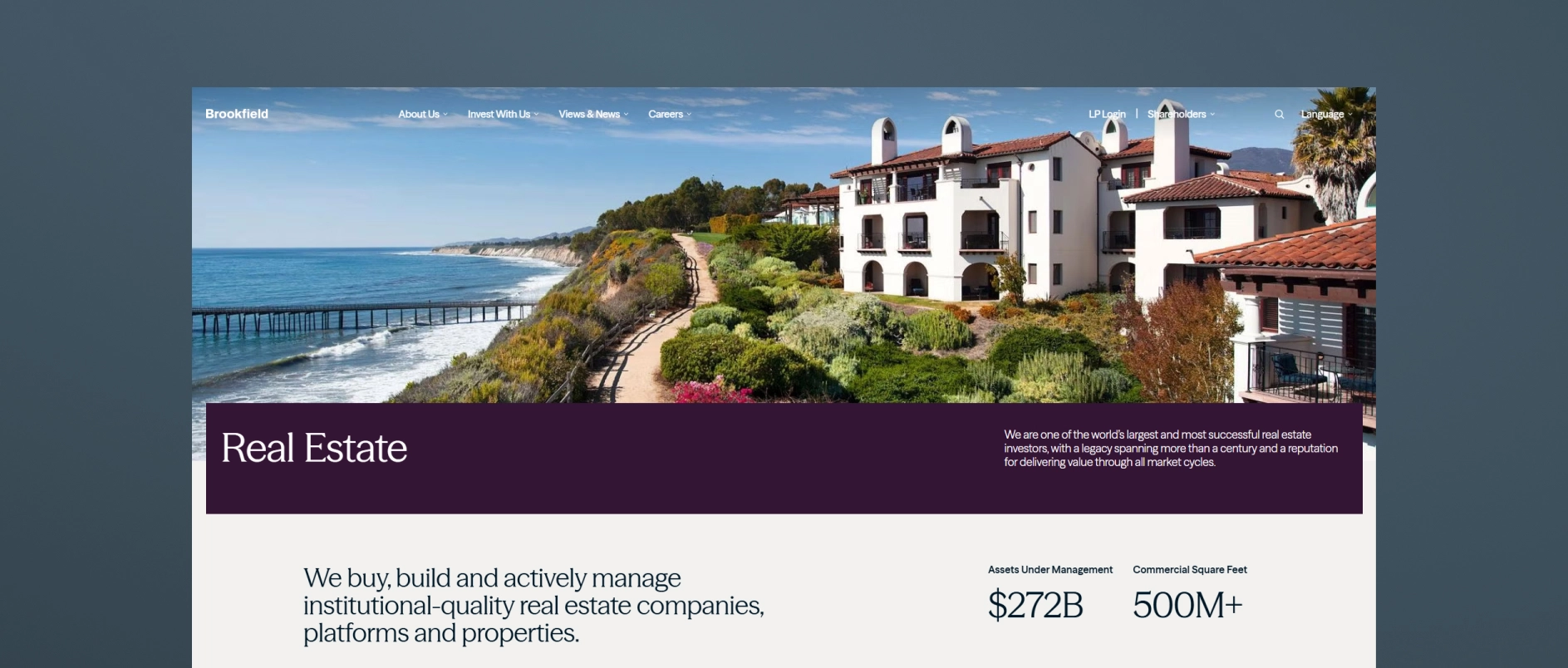
Public examples, including large diversified real estate firms, often use this model because it scales well across product types and allows microsites to sit cleanly alongside parent-brand pages.
What to watch for
Platform-forward structures depend heavily on navigation clarity. Without intuitive menus, users may feel uncertain about where to begin. For wealth-channel products, creating a clear “Advisor Resources” path or standalone microsites avoids crowding the institutional narrative.
How to Choose the Right Structure
Align the website architecture to strategy complexity, audience mix, and communication goals
Choosing among these three models is less about preference and more about determining which architecture helps an audience understand the firm with the least friction.
For multi-market platforms, that choice is often what turns complex messaging into a clear digital narrative.
Use Thesis-Forward when:
- The differentiator is how you think, not how many strategies you offer
- You are an emerging manager or a sector specialist
- Your thesis provides meaningful context for interpreting performance or portfolio decisions
Use Portfolio-Forward when:
- Real examples illustrate the strategy better than abstract explanation
- You want to highlight vertical integration or operating capability
- The assets themselves help clarify scale, market focus, or execution style
Use Platform-Forward when:
- You need to serve multiple audiences with different needs
- Your offerings span institutional LPs, advisors, and/or retail investors
- Complex products require separate microsites or tailored disclosure frameworks
For many firms, hybrid models work well. For example, a thesis-forward homepage paired with a platform-forward navigation bar, or a platform-forward main site supplemented by product-specific microsites.
What matters most is that the structure supports, rather than complicates, the story. An allocator, advisor, or investor should understand where to go and what matters within moments.
Closing Thought
A real estate manager’s website is a structural expression of the brand. The right architecture helps users grasp the strategy’s intent, the platform’s capabilities, and the path to deeper engagement. The wrong one adds friction before the strategy is ever considered.
By choosing a design model aligned with strategy complexity and communication priorities, managers create a clearer narrative environment where their strengths can be understood quickly and responsibly.
Choosing the right one is the first decision in our work on websites for real estate investment managers.



Among early-stage investment firms, one topic often discussed quietly but rarely articulated clearly is how to position a capital base that isn’t predominantly institutional. “Non-institutional capital” can refer to family capital, corporate capital, multigenerational ownership, strategic partners, or a single sponsoring entity. These structures vary widely, but they often share a defining attribute: flexibility. And when framed well, flexibility becomes one of the most compelling parts of a firm’s identity.
The challenge is not a lack of credibility. The challenge is that these structures do not come prepackaged with a familiar narrative. Institutional capital has an established vernacular. Non-institutional capital requires teams to express its strengths more intentionally. That effort, in itself, can become a strategic advantage.
The opportunity for early-stage managers is to articulate how their capital structure supports thoughtful, steady, and well-aligned investing.
1. Begin With What the Capital Base Enables, Not What It Is
Descriptions of capital composition rarely resonate on their own. What tends to matter more is the way those structures shape the firm’s approach and relationships.
A flexible capital base can support:
- A long-view posture without predefined timelines
- The ability to prioritize high-quality opportunities even when pacing is not the main driver
- Strong alignment among stakeholders, owners, or partners
- Stability during periods when markets or operating conditions shift
- The freedom to stay engaged as companies or clients evolve
These are not theoretical benefits. They influence how firms build partnerships, make decisions, and allocate attention.
The takeaway:
Lead with what the structure empowers, not the structure itself.
2. Translate Flexibility Into a Narrative Pillar
Flexibility becomes meaningful when it is part of a broader narrative that reflects how the firm operates.
Many early-stage firms find that narrative pillars emerge naturally from their structure, such as:
- Enduring Partnership: Supporting strong businesses or clients over extended horizons
- Disciplined Patience: Acting when the right circumstances emerge, not because the calendar dictates it
- Conviction Over Velocity: Selecting opportunities based on alignment and long-term potential
- Shared Alignment: Stakeholders who hold a consistent view of progress and value creation
These themes help audiences understand the philosophy behind the structure without dwelling on the structure itself.
3. A Brief Example: When Structure Illuminates Philosophy
In recent work with an earlier-stage emerging manager, our team helped clarify how the group’s unique capital base supported its long-term approach to building strong businesses. Rather than presenting the structure as a technical attribute, we framed it through the lens of what it made possible: freedom from predetermined timelines, consistency of alignment, and the ability to develop multi-year partnerships grounded in trust.
By expressing the structure through philosophy and behavior — not form — we helped the team tell a story that felt both substantive and intuitive. It became clear that the capital base wasn’t an exception to explain, but a strategic asset that shaped how the firm showed up.
This type of reframing can apply to many early-stage firms with flexible capital foundations.
4. Use Proof Points That Show Behavior, Not Structure
A capital base becomes compelling when it produces observable behaviors. Proof points demonstrate how the structure shapes decisions and relationships, without requiring detailed disclosures.
Examples include:
- Staying engaged through meaningful company or client transitions
- Showing steadiness when markets or operating conditions shift
- Maintaining a thoughtful sourcing cadence rather than reacting to pacing pressure
- Encouraging decisions that prioritize long-term compounding
- Providing consistent, calm support to leadership teams or clients
These behaviors help audiences understand the practical implications of the firm’s capital base.
5. Position the Capital Base as a Strategic Asset Using a Clear Framework
A simple internal framework can help teams articulate the advantages of their capital base clearly and consistently.
A Framework for Articulating Capital Base Advantages
This framework works across websites, decks, outreach materials, and conversations.
6. Avoid Framing the Structure in Comparative Terms
Terms like "non-institutional capital" can be accurate descriptively but are rarely the strongest narrative choice. They define the firm by comparison rather than by intention.
A clearer approach is to articulate:
- The advantages the structure provides
- How it influences the firm’s investing and partnership style
- The behaviors it enables
- The values it reinforces
Framing the structure on its own terms creates a stronger, more confident narrative.
7. Integrate the Capital Story Into Your Broader Message Architecture
A capital base narrative gains strength when it is aligned with the firm’s message architecture. This ensures that structure, philosophy, sourcing, diligence, and partnership stories reinforce each other across:
- Websites
- Pitch decks
- Sourcing outreach
- Introductory conversations
- Case studies (anonymous if needed)
- Videos and founder-facing materials
The goal is not to spotlight structure in every touchpoint. It’s to let structure inform how the firm shows up — calm, patient, aligned, and steady.
In practice, that means treating the capital story as one pillar within a broader messaging architecture for Fund I, not as a standalone talking point.
Closing Thought
For many early-stage investment firms, a non-institutional capital base is not a constraint but a powerful source of differentiation. When articulated thoughtfully, it becomes a narrative advantage: a way to signal alignment, patience, and intention in a crowded landscape.
The firms that tell this story well don’t present their structure as an anomaly. They present it as a foundation — one that enables them to build relationships and companies with the clarity and confidence required for long-term success.



The hardest part of emerging manager fundraising is not the pitch meeting itself. It’s what happens after the meeting — when an LP walks out, stacks your story next to a dozen others, and has to remember two or three things about you well enough to repeat them internally. This is where narratives either survive or collapse. And most emerging manager narratives collapse because they were never designed to withstand that moment.
A Fund I or Fund II story has to do more than describe a strategy. It has to organize the LP’s memory. It has to make the GP’s worldview accessible, repeatable, and distinct enough that someone who wasn’t in the room can still understand why the idea might be worth a second look in the next cycle.
The reason so many emerging managers struggle here is structural: they think about narrative as explanation, when LPs experience it as architecture. A clear story is not a chronological recounting of your experience or a list of your differentiators. It is an organized system of ideas — origin, category, thesis, edge, proof — that stack in a way LPs intuitively understand. And when that system is well built, the downstream conversations become dramatically easier because the LP already knows how to think about you.
1. Narrative Begins With Category, Not Strategy
Emerging managers often begin their pitch with the specifics of what they do: their sourcing channels, their underwriting criteria, their sector knowledge, their deal lens. But LPs are not ready for that level of detail until they have a mental model of the category you operate in.
Narrative starts one layer up: What market are you playing in, and why does it make sense?
Most EMs underestimate how little LPs know about the nuances of sub-strategies, niche asset classes, or operational dynamics. If you don’t define the category clearly, the LP will place you into whatever adjacent bucket feels most familiar. And once the LP categorizes you incorrectly, it is extraordinarily difficult to pull the narrative back.
A good emerging manager narrative establishes the category in one or two sentences — simple enough that a non-expert could repeat it, specific enough that it doesn’t collapse into something generic. Only then does strategy begin to make sense.
2. The Strategy Must Emerge Naturally From the Category
Once the category is clear, the strategy has to feel like the obvious response to the underlying market structure. Emerging managers often give LPs a strategy that feels theoretically interesting but disconnected from the opportunity they just described. The jump is too big. The linkage is missing.
LPs respond most strongly to strategies that feel structurally inevitable — where the GP’s approach reads as the logical answer to the problem the category presents. When the strategy grows naturally out of the category, the LP not only understands what you do; they understand why you do it.
Narrative is persuasion through architecture. When the staircase is built correctly, the LP moves up it without noticing.
3. The Edge Must Be Singular, Not a Catalog
Most emerging managers have an instinct to list every possible advantage: sourcing network, operating experience, market insight, proprietary pipeline, a differentiated take on value creation. But lists do not create memory. They create blur. LPs retain one thing. Maybe two. Never five.
A strong narrative surfaces one primary edge — the thing that truly makes the manager distinct — and supports it with secondary ideas that reinforce the same conclusion. When the edge is singular and well chosen, everything else becomes supporting architecture instead of narrative clutter.
The strongest emerging manager edges are usually:
- behavioral (how they think or operate),
- structural (where they sit in the market), or
- experiential (what they understand more deeply than peers).
The edge is not a feature; it is a worldview. If it cannot be expressed cleanly, it will not survive LP translation.
4. Proof Must Be Narrative, Not Decoration
Emerging managers often misunderstand what “proof” means in early fundraising. Without formal attribution, many EMs treat their past deals as cosmetic reinforcement — color, context, background. But LPs don’t experience proof as biography; they experience it as evidence that the GP thinks clearly and acts consistently.
The past matters when it supports the narrative spine. A deal example is not meant to show that you were involved in something impressive. It is meant to demonstrate that the edge you’ve claimed actually manifested in the real world. The deal should feel inevitable in retrospect, as if the GP could not have acted differently.
When proof is narrative, not decoration, LPs internalize it as part of the story rather than trivia.
5. The Test of a Good Narrative Is Portability, Not Eloquence
Managers often assume that if they explain their strategy elegantly, they’ve succeeded. But most LPs do not make decisions in isolation. Their colleagues, committees, and consultants become part of the narrative chain. If the story dies in translation, the strategy dies with it.
The real test of narrative is whether someone who has only heard it once can still explain:
- the category
- the approach
- and the edge
without losing the thread.
In practice, this means emerging manager narratives must sacrifice eloquence in service of durability. A narrative that sounds refined in the room but collapses later is less effective than one that feels simple in the moment but survives for months.
Narrative durability is a design choice.
That durability is tested most visibly on the website, where an emerging manager’s narrative actually takes shape online for most LPs.
Closing Thought
Emerging managers often think their challenge is storytelling. In reality, it is structure. LPs remember what the narrative architecture makes memorable. A coherent category, an inevitable strategy, a singular edge, and proof that reinforces the thesis — those are the bones of a story that lasts.
You cannot control when an LP moves. But you can control whether your story is still intact when they think about you again in three years. That, more than anything, is the difference between a Fund I narrative that dissipates and one that compounds.


Emerging managers tend to assume LPs will judge them on strategy quality, pedigree, relevant experience, and whatever informal track record they can reasonably claim. Those things matter. But early on, they’re rarely what decides the meeting. In the first few conversations, an LP isn’t ranking your strategy against other strategies. They’re trying to work out whether you’re investable at all, which is a different test than most managers walk in prepared for.
What LPs look for first is readiness. Before they form a view on the strategy, they need to believe you’re far enough along in building an institutional firm to justify a second meeting. A Fund I or Fund II allocation is partly an underwriting call and partly a read on the GP: Is this organization mature? Do they understand how institutional capital actually gets raised? That read happens fast, often before the strategy discussion is even finished.
I’ve worked with emerging managers for about ten years, and the early judgments LPs make tend to fall into three buckets: coherence, credibility, and compression. Managers who clear those early have a much easier conversation afterward. Managers who don’t can have a genuinely sophisticated strategy and still struggle, because the LP hasn’t settled the more basic question of whether the firm is real.
1. Coherence: LPs Need a Story They Can Repeat Accurately
LPs don’t retain detail the way managers think they do. They see a steady stream of first-time funds and repeat funds, and a lot of strategies that sound alike. They also have to summarize you later, often to a colleague or committee member who wasn’t in the room. If your story doesn’t survive that retelling, the strength of your ideas inside the meeting doesn’t count for much.
In practice, coherence means explaining who you are and what you do in terms LPs already use: a clear category, a defined strategy, a narrow edge they can believe. Many emerging managers lean on nuance, hoping it signals sophistication. Usually it just makes them harder to describe. If an LP can’t sum up your strategy in two or three sentences, the odds of a second meeting drop sharply. That has less to do with whether they liked you than with whether they can remember what you do.
2. Credibility: LPs Need to Believe You Are “Institutionally Ready”
Experience and credibility aren’t the same thing. LPs meet plenty of managers with impressive backgrounds and deep transaction exposure. Credibility is narrower. It’s the sense that this manager can run a disciplined process, communicate clearly, hold up under diligence, handle surprises, and act like a fiduciary.
That’s why brand and narrative matter more than most emerging managers expect. An LP can’t watch your underwriting or see how you behave when a deal goes sideways. They can see whether your materials are organized, whether your website looks considered, whether your messaging holds steady from one meeting to the next, and whether you talk about your strategy the way a professional allocator would evaluate it.
No LP will tell you your deck looked sloppy so they assumed your underwriting was too. But that inference gets made all the time. LPs are scanning early for disqualifiers: vague strategy language, design that doesn’t match the firm’s positioning, a narrative that rests entirely on pedigree, a website that looks like a template rather than an investment firm. None of these is fatal alone. Together they add up to an impression that the manager isn’t quite ready for institutional money.
You can’t claim credibility directly. LPs infer it from the decisions you’ve already made.
3. Compression: LPs Need You to Get to the Point Faster Than You Think
The most common problem I see with emerging managers is overexplaining. Early in a firm’s life, everything feels essential: every deal, every operating insight, every detail of the sourcing advantage. LPs don’t give unlimited attention, though. They decide quickly whether the core of the strategy makes sense and fits their mandate.
Compression takes discipline. You have to decide what actually matters and drop what only matters to you. When I was raising for BKM Capital Partners in 2014, it took us far too many slides to explain the multitenant industrial thesis. We tightened it eventually, but the early version buried the main point under a pile of detail. I didn’t appreciate until later how often managers do the same thing, usually because nobody has ever forced them to name the one or two ideas that define their strategy.
LPs form early impressions on clarity. When a manager can explain the strategy simply and still sound like they know what they’re doing, LPs lean in. When it takes fifteen minutes of backstory to get there, they start tuning out.
Closing Thought
LPs have to understand you before they can like you, and they need to believe you’re prepared before they’ll put in the effort to understand you. That belief comes from a story that holds together on its own and is clear, credible, and short enough to be retold accurately after you’ve left the room.
Emerging managers often treat fundraising as a test of their strategy. Early on, it’s mostly a test of their clarity. The strategy gets its hearing once the LP has decided the firm is institutionally real.


1. The Legitimacy Gap: The Real Problem Emerging Managers Face
After working with hundreds of emerging managers across private equity, real estate, credit, and niche alternatives, you start to notice the real patterns — not the optimistic conference panels, but the structural truths shaping Fund I, Fund II, and Fund III trajectories. “Emerging manager” is a broad term, but what unifies this group isn’t AUM or asset class. It’s that they are early in their institutional story, and LPs can usually tell immediately.
The obstacle is the legitimacy gap — the distance between how a manager sees themselves and how an LP perceives their readiness. Strategy, pedigree, and track record matter, but legitimacy is the threshold condition that determines whether anyone will take the next step. In plain terms: Darien Group helps emerging managers close the legitimacy gap faster than they could on their own.
2. The Nonlinear Reality of Early Fundraising
Most emerging managers understand conceptually that fundraising will be hard, but many still assume it will follow some recognizable pipeline. In reality, Fund I and Fund II almost never move in straight lines.
When I worked at BKM Capital Partners during their first fundraise, the expectation was that friends and family would anchor $25–50 million. They didn’t. The turning point came from a single Scandinavian LP who happened to be in Los Angeles for one day. We were taking twenty meetings a week; that one meeting changed the trajectory.
You do not know which meeting matters — and you cannot engineer the sequence.
What you control is your consistency. Everything else is unpredictable.
3. LPs Often Don’t Understand Your Category — And You Must Bridge That Gap
Another structural reality is that LPs often don’t understand a category nearly as well as the GP assumes. At BKM in 2014, multi-tenant industrial was seen as non-institutional: too small, too operational. Five years later, it was a multi-billion-dollar institutional staple.
Much of that gap was closed through education. Brian Malliet produced extensive collateral not because he liked marketing, but because emerging managers often have to demonstrate that the category itself deserves institutional attention. Today’s emerging managers know they need a website and a pitchbook, but they still underestimate how much education is required — and how high the bar has become.
Clearing that bar is largely a positioning and messaging problem: the category has to be explained before the strategy can land.
4. Why Some Emerging Managers Break Through — and Most Don’t
The managers who eventually succeed distinguish themselves in ways that have little to do with polish or charisma. They stay consistent when the market is slow to respond. They specialize instead of drifting toward generalist territory. And they choose strategies the market actually wants.
You cannot brand or design your way out of a weak thesis. You cannot out-pedigree an established incumbent. But if you are the sharpest expression of a category the market is curious about — and you communicate that clearly — you will eventually find the LPs who recognize it.
Consistency and specialization beat cleverness and pedigree.
This is a quiet truth people don’t say out loud, but it is one of the defining characteristics of the managers who make it.
5. The 10-Year Journey: How LPs Actually Form Memory
The “10-year journey” is not a motivational slogan. It is the psychological structure of emerging manager fundraising. Nearly every Fund I manager hears: “We like it — come back for Fund II.” It isn’t always dismissal. LPs can only allocate to a small set of new managers each cycle; the rest are catalogued for later.
Here is the rough math:
- Most early meetings won’t produce capital.
- A minority will matter years later.
- The decisive ones often surface unexpectedly.
LPs remember only two or three things about you. Those things must be durable enough to make sense when they see you again in three years.
6. LPs Look for Disqualifiers First—Often Before They Look for Strengths
Emerging managers tend to assume LPs are evaluating them with optimism. In reality, LPs begin in filtering mode. Whether the LP is a CIO at a major institution or a sophisticated family office, they make early judgments based on coherence, clarity, and organization.
Common disqualifiers include:
- sloppy, outdated, or overdesigned materials
- messaging built entirely on pedigree
- jargon without a point of view
- broker-like or developer-like websites
- lack of clear specialization
- strategy drift or narrative drift
LPs evaluate operational discipline through brand and materials. If your deck is disorganized, they assume your underwriting is disorganized. These judgments form much earlier than most emerging managers imagine.
7. What Institutional Legitimacy Actually Looks Like at the Beginning
Legitimacy at Fund I or Fund II isn’t about appearing large; it’s about appearing ready. A coherent brand, a credible website, a pitchbook that withstands scrutiny, sober expectations, and a strategy distilled into a few memorable ideas go much further than managers expect.
If you are young in “fund years,” your brand has to do a little extra work to signal maturity. This isn’t pretense — it’s optics, and LPs react to it immediately.
8. The True Purpose of a Fund I Pitchbook
Most emerging managers misunderstand this. A Fund I pitchbook is not theatrical persuasion. It has two practical responsibilities:
- Establish the category — especially if it is new, evolving, or misunderstood.
- Establish your ownership of it — why your angle is sharper or more structurally advantaged.
Even in HNW settings, the deck is usually forwarded internally. It must be designed to withstand that level of scrutiny.
9. The Mindset Shift from Syndications to Funds
Transitioning from deal-by-deal work to fund management requires a different time horizon. Syndications reward episodic success; funds reward sustained progress. Many syndicators attempting Fund I never close it — not because they lack talent, but because the strategy doesn’t scale or they lose momentum before the flywheel turns.
In many cases, Year 1 is quiet; Year 2 is where traction appears. Fund I is not the destination. It is Chapter One in a multi-fund arc.
10. What Darien Group Actually Does for Emerging Managers
We are not here to make an emerging manager look like a billion-dollar platform. Nor are we here to gloss over weak strategies. Our role is to help managers articulate a coherent, durable narrative; sharpen their point of view; build materials that won’t age poorly; and find the intersection between professionalism and personality.
Or, said more bluntly:
We help emerging managers close the legitimacy gap faster, so they can spend more of their energy actually building the track record that will carry them forward.
11. The Fundamentals Haven’t Changed — But the Bar Has
Capital raising has changed more in the last four years than in the previous decade. Expectations are higher. LPs filter faster. But the fundamentals remain constant: a coherent category, a compelling strategy, a durable story, and consistency over time. Emerging managers can’t control how long momentum takes to form, but they can control the clarity and maturity of the story they tell.
Everything else sits downstream of legitimacy.


Annual General Meetings ("AGMs") in real estate are usually viewed as a reporting milestone: update the numbers, refresh the case studies, adjust the market slides, and distribute the deck. But increasingly, the AGM is becoming something more consequential — a moment when managers step back and reconsider how they are telling the story of their platform.
It’s one of the few points in the year when investment, operations, and IR align around the same question:
Does our narrative accurately reflect who we are today and the strategy we need to express in this cycle?
When approached thoughtfully, the AGM doesn’t just summarize performance. It becomes a strategic reset — an opportunity to refine positioning, sharpen the thesis, and ensure the story LPs encounter is the story the firm intends to tell. And because AGM decks often circulate long after the meeting itself, they carry disproportionate influence in shaping how stakeholders interpret the platform for the year to come.
AGMs Surface Narrative Gaps That Day-to-Day Materials Don’t
Across the industry, we see a recurring pattern: firms with strong platforms and disciplined execution often present narratives that undersell their sophistication. The AGM process tends to expose those disconnects, in large part because managers are forced to revisit assumptions they may not have revisited in months or even years. Here are three of the common missteps Darien Group looks out for in AGM materials:
1. The investment thesis is implied, not articulated.
Managers know why they pursue a strategy, but the rationale often lives in the heads of senior leadership, not in the materials themselves. The AGM forces clarity: What is your interpretation of the market today? What are you solving for? Why now?
This clarity becomes especially important in cycles where macro narratives overwhelm sector nuance. If managers don’t explicitly articulate the logic behind their strategy, others will fill in the gaps.
2. Execution advantages are real but invisible.
Decision-making speed, cycle-tested judgment, operating discipline — these strengths don’t always make their way into the narrative. AGM preparation reveals where the story lacks depth or specificity.
Many platforms assume these capabilities “speak for themselves.” In practice, they rarely do. The AGM invites teams to translate their operating DNA into language that external audiences can recognize and understand.
3. The deck reflects last year’s market, not this year’s cycle.
Real estate is uniquely cyclical. A slide that worked in one market environment may dilute the story in another. The AGM is a natural checkpoint for recalibrating what the materials need to communicate now.
Often, what needs to change isn’t the strategy itself — it’s the frame. When the market context changes, the narrative must evolve to reflect the new conditions in which the strategy is being executed.
“The AGM is one of the rare moments when LPs expect — and welcome — a refreshed point of view. If the story is evolving, this is the place to show it.”—Jessica Haidet, Director of Brand Strategy at Darien Group
Four Reframing Moves That Strengthen an AGM Narrative
In our work helping real estate platforms clarify and sharpen their messaging, four narrative shifts consistently strengthen the AGM story. These shifts don’t require changing the strategy, rather expressing it with greater clarity, coherence, and strategic intent.
The same moves guide our AGM and investor day support for real estate managers.
1. Lead with the thesis, not the assets.
Many managers instinctively begin with recent acquisitions or property-level results. But a stronger AGM narrative opens with market interpretation — clear, concise, and specific to the environments the firm operates in.
A thesis-led opening establishes context before the details appear. It helps audiences understand not just what you’re investing in, but why the moment matters. Without this context, even strong performance can appear disconnected from broader market forces.
2. Elevate the mechanics that make the strategy work.
AGM decks often include the what — recent acquisitions, occupancy figures, capital plans — but underemphasize the how. The details that distinguish one platform from another:
- What enables sourcing advantage
- How underwriting differs from peers
- Where operational sophistication shows up
- How the team adjusts as the cycle shifts
These elements often represent the firm’s true edge, yet they remain underexpressed unless intentionally surfaced. AGM season allows managers to translate operational nuance into strategic clarity.
3. Show the maturity of the platform — visually and structurally.
AGM materials function as an interpretive frame. When the deck is modern, clear, and structured intentionally, it conveys organizational coherence and operational discipline. When materials appear dated or overly developer-like, they can unintentionally suggest a less institutional posture.
Even simple adjustments — cleaner slide hierarchy, crisper language, more intentional ordering — can meaningfully change the impression a platform creates.
4. Make the “so what” unmistakable.
AGMs give managers the opportunity to connect the dots between what the platform does and what that means for investors. The implications are often the missing layer:
- How the firm’s capabilities contribute to consistency
- How execution discipline supports long-term outcomes
- How the strategy aligns with current market dynamics
- What advantages capital partners gain by investing with this team
Rather than assuming the meaning is self-evident, AGM presentations allow managers to articulate it directly. When managers explain not just the mechanics of the strategy but the significance of those mechanics, the deck becomes a far more powerful communication tool.
Why This Matters Especially Now
Capital is selective, cycles are complex, and attention is finite. Firms that communicate clearly — not just operate well — position themselves more effectively. The AGM is often the only moment where the entire strategic narrative is reconsidered rather than merely updated.
A strategically reframed AGM narrative helps managers:
- Reassert where their strategy fits in the current environment
- Demonstrate conviction through clarity, not volume
- Reduce interpretive effort for LPs
- Translate operating strengths into understandable signals
- Strengthen the through-line between past performance and future opportunity
- Inform investors of upcoming funds and strategic shifts
This is especially important in moments when performance alone cannot carry the story. A clear narrative can contextualize challenges, highlight durability, and position the platform as thoughtful and cycle-aware even in periods of uncertainty.
In cycles where differentiation is harder to articulate, a well-structured AGM becomes one of the most effective storytelling tools a real estate manager has, both internally and externally.
The Takeaway: The AGM Isn’t Just Reporting — It’s Repositioning
Real estate managers who treat the AGM as a strategic moment — not a procedural one — tend to emerge with clearer messaging, stronger alignment, and a more coherent expression of their platform.
The goal is not reinvention. It’s coherence.
A strong AGM communicates:
- A thesis that reflects the cycle
- A strategy that aligns with that thesis
- A team whose discipline and maturity are evident
- A platform whose story is as strong as its execution
When these elements lock into place, the AGM becomes more than a backward-looking update — it becomes the annual opportunity to sharpen the identity of the platform itself. And because AGM materials often influence conversations long after the meeting, the impact of this work extends far beyond the hour it is presented.
